Smyrna Tree Removal has been doing tree trimming and structural pruning in Middle Tennessee for more than twenty years, on subdivision shade trees, older street-side canopy and commercial grounds in Smyrna, TN and serving surrounding cities including La Vergne, Nolensville, Murfreesboro, Brentwood and Mount Juliet. Every cut is made to a stated objective, and the objective goes on the estimate before anyone climbs.
That sounds like a small distinction and it is the whole difference between pruning and trimming as most people experience it. “A trim” is a price with no definition, which is why two quotes for the same tree can differ by a factor of three and why the cheap one often comes back as a problem. The ANSI A300 standard gives the operations names and rules, and naming which one you are buying is the only way to compare anything.
The loads matter too. Ice storms are a documented structural agent in this ecoregion rather than regional decoration, and the crowns around here fail at their unions under glaze before they fail anywhere else. Pruning that ignores that is decorative work sold at tree-work prices.
Pruning Objectives Under the ANSI A300 Standard
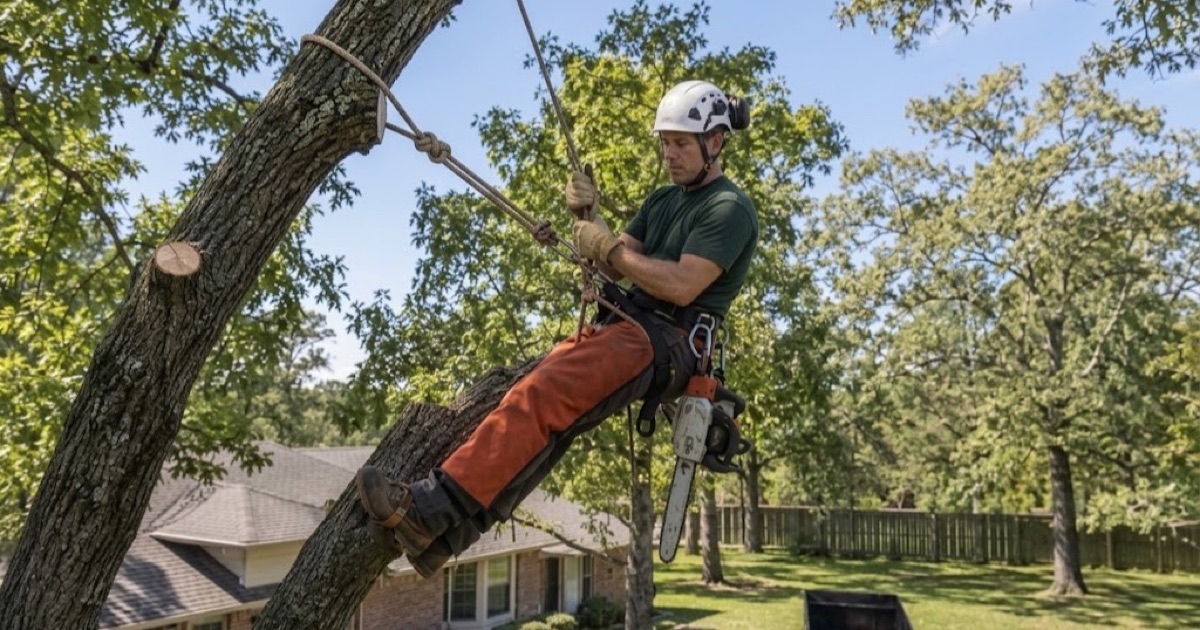
Crown Cleaning and Deadwooding
Crown cleaning is the removal of dead, dying, diseased and broken branches, and it is the most commonly needed operation on a mature tree. Deadwooding a large oak over a patio removes the pieces most likely to come down without warning, changes the crown’s appearance very little, and is often the whole of what a healthy tree actually requires.
Crown Raising for Real Clearance
Crown raising lifts the lower limbs to give clearance over a lawn, a drive, a sidewalk or a roof. The limit is how much live crown a tree can lose from the bottom before the trunk taper and the reserves suffer, so raising is worked gradually rather than in one aggressive lift. The town’s own landscape section treats a five-foot clear trunk as the baseline on required trees.
Crown Reduction and Crown Thinning
Reduction shortens leaders and branches back to laterals large enough to assume the terminal role, which lowers the lever arm on a heavy limb without leaving stubs. Thinning removes a proportion of the smaller live branches throughout the crown to open it selectively. They are different tools for different problems, and reduction is what a homeowner asking for topping usually actually wants.
What We Will Not Do to a Tree
Topping, and the Town’s Own Position on It
Topping cuts limbs back to stubs with no lateral to take over, and the tree answers with dense, weakly attached regrowth that fails under the next glaze. Smyrna’s landscape regulations rule it out by name as maintenance, defining it as cutting limbs to stubs larger than three inches inside the crown to the point of removing the normal canopy. We decline the request and quote reduction instead.
Lion-Tailing and Over-Thinning
Stripping the interior branches and leaving foliage bunched at the ends of limbs looks tidy from the driveway and it is structurally the worst thing a crew can do to a shade tree. It concentrates weight at the tips, removes the taper-building growth along the branch, and increases the whip a limb takes in wind. Thinning is done through the crown, not from the inside out.
Flush Cuts and Stub Cuts
A cut made flush to the trunk removes the branch collar the tree uses to seal the wound, and a stub left long never seals at all. Both are visible for the life of the tree and both invite decay into the stem. Cut placement at the collar is unglamorous, it is the part of A300 that survives longest, and it is not negotiable on our jobs.
Pruning for the Loads This Region Puts on a Crown
Ice Loading and Where a Crown Gives First
Glaze loads a crown from the outside in, and the failures start at unions rather than mid-span on a sound limb. A crown carrying co-dominant stems with included bark is carrying its weakest point at its highest-stress location. Pre-season work concentrates on reducing end weight over those unions and clearing the dead wood that a load will find first.
Straight-Line Wind and Sail Area
Wind failures here are as often a whole tree turning out of saturated ground as a limb tearing off, because rooting depth is capped by rock and the root plate is wide and thin. That changes the pruning brief: the aim is measured reduction of end weight and sail area on the exposed side, not a hollowed-out crown that flexes worse than it did before.
Clearance from Roofs, Gutters and Chimneys
Limbs resting on shingles abrade them in every breeze, and carriers increasingly write to owners about overhanging branches before a roof claim ever happens. Clearance pruning cuts back to laterals so the gap holds for several seasons rather than growing back inside a year, and we photograph the before and after so the correspondence with an underwriter is short.
Species That Need Different Hands
Callery Pear and Silver Maple
Both were planted through these neighborhoods in quantity and both build crowded, steeply angled unions full of included bark. On a young specimen, structural pruning that removes competing leaders early is genuinely preventive. On a mature one that has already split, the honest conversation is about cabling or removal rather than another round of cuts.
Oaks, Hickories and the Timing Question
White oak, post oak and chinkapin oak dominate the native canopy on this side of the basin, and they are best pruned in the dormant season for disease reasons rather than convenience. Shagbark hickory and other slow-compartmentalizing species reward conservative cuts. Where an oak needs urgent hazard work in summer, we do it and treat the timing as the tradeoff it is.
Leyland Cypress and Evergreen Screens
Leyland cypress planted as a quick screen at spacing suited to a small plant shades out its own interior within a decade, and it does not regenerate foliage from bare wood. Shearing back into that dead zone leaves a permanent hole. The useful work is light annual maintenance while the plant is young, and staged replacement once a row has gone bare at the base.
Utility Clearance and the Line to Your House
The Right-of-Way Is Not Your Tree’s Whole Story
Middle Tennessee Electric publishes a right of way 40 feet wide, 20 feet on each side of the line, and its crews cut back or eventually remove what grows inside it. What that leaves is everything outside the corridor, which is the owner’s, and the parts of a crown a utility trim has left one-sided. We work the remainder to a shape the tree can actually hold.
The Service Drop to the Weather Head
The line running from the pole to the house sits outside most utility maintenance programs, and MTE states that it prunes only a five-foot radius around service lines during its regular cycle. That is why a limb growing into the drop is a private crew’s job, and why an owner who calls the utility about it is usually told to hire somebody.
Scheduling a Drop Before the Climb
Where a service line has to be de-energized or physically dropped, that is arranged with the correct provider ahead of the work date rather than on the morning. Four different utilities serve addresses across this area, each with its own policy and its own lead time, so we confirm which one covers the meter before the schedule is set.
- 20+ Years in Middle Tennessee
- Free Written Estimates
- ANSI A300 Pruning, No Topping