Smyrna Tree Removal has been diagnosing and treating tree disease and decline across Middle Tennessee for more than twenty years, on yard trees, street-side canopy and commercial grounds in Smyrna, TN. Most of what arrives as a disease question turns out to be a site question, and separating the two is the whole value of the visit.
That is not a regional generalization. Rooting depth on much of this ground is capped by limestone within a foot or two of the surface, the soils are clayey residuum that compacts readily, and they swing from dry through summer and autumn to saturated through winter and spring. A tree here is already working with a narrow margin, so a grade change, a driveway or a season of machine traffic pushes it further than the same insult would elsewhere.
We look at the root collar before we look at the leaves, we say what we can and cannot determine from the ground, and we tell you when the correct treatment is a removal. A plant health program that never reaches that conclusion is selling visits rather than answers.
Diagnosing Before Treating
Reading the Crown
The crown records the last few seasons if you know what to measure. Twig extension tells you what growth the tree managed last year and the year before, and dieback that starts at the tips and works inward points somewhere very different from dieback confined to one side or one limb. We record those observations rather than describing a tree as “stressed” and moving on.
What the Root Collar Says
More declining trees in these subdivisions are failing at the base than are failing from anything airborne. A flare buried by regraded fill or a mulch volcano stays wet, rots, and produces a crown that looks vaguely unwell for years. Girdling roots circling a stem from a nursery container do the same thing more slowly. Both are visible once the collar is opened, and invisible until then.
When to Look Closer
Some questions cannot be settled from the ground: decay extent inside a stem, a defect at a high union, or a pathogen that needs a sample and a laboratory. We say when that is the case, price it separately, and only recommend it where the answer would actually change what we do. Testing that cannot change the plan is an expense, not information.
The Problems We See Most Here
Emerald Ash Borer and Standing Dead Ash
Ash killed by emerald ash borer loses wood strength quickly and stops being safe to climb, which is why a dead ash is taken down with a crane or a lift rather than a rope and saddle. Tennessee repealed its emerald ash borer quarantine in 2021, so nothing restricts what happens to the wood within the state, but the structural clock on a standing dead ash keeps running.
Decay Fungi and Conks at the Buttress
A conk is the visible end of a process that has been running inside the stem for years. What matters is how much sound wall remains around the circumference and where the decay column sits relative to the load. We excavate, sound the base and quantify what is left, because a decayed root plate on shallow soil is precisely the failure that arrives during a saturated winter.
Spotted Lanternfly, Honeydew and Sooty Mold
The Tennessee Division of Forestry’s map current to June 2026 lists confirmed spotted lanternfly populations in Davidson, Wilson, Sullivan, Sumner, Hamilton and Jefferson counties, with Rutherford not among them although two of those adjoin it. The state’s position is that the insect stresses trees rather than killing them outright, and the honeydew and sooty mold on cars and patios are what owners notice first.
Treatment That Addresses the Cause
Soil Decompaction and Radial Trenching
Where construction traffic or years of mowing have closed the pore space, the treatment is mechanical. Compressed air work opens the soil without shredding roots, radial trenching brings amendment into the root zone along spokes, and mulch over the treated area keeps it open. On a tree already limited by depth to bedrock, that recovered volume is a large proportion of what it has.
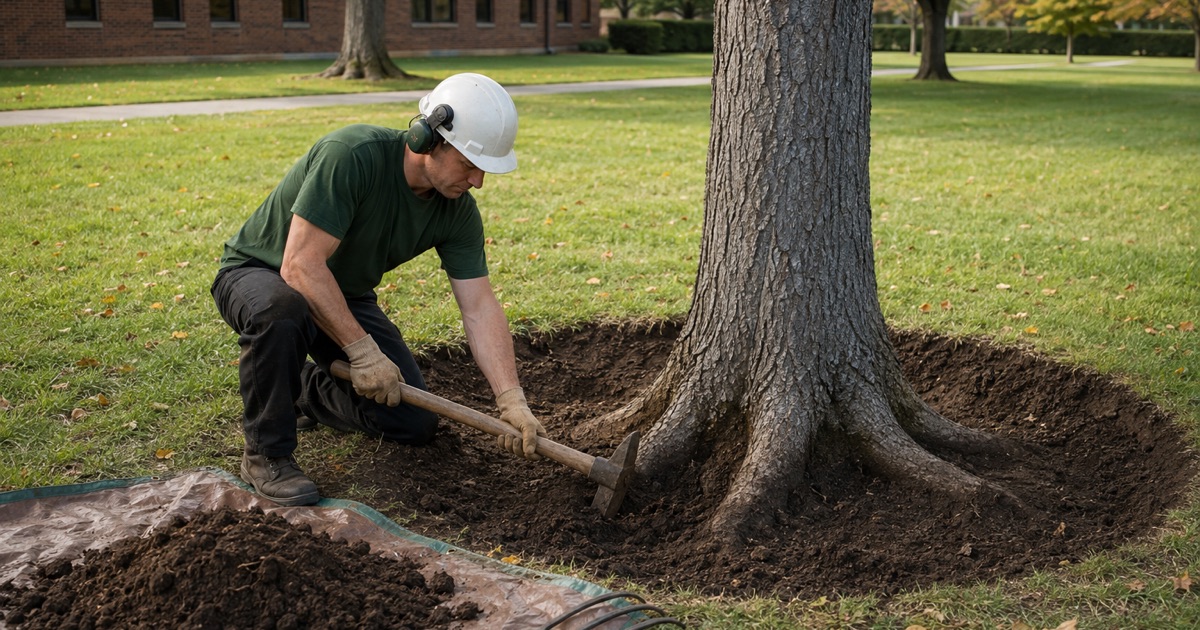
Root Collar Excavation With an Air Spade
An air spade removes fill from around a buried flare without cutting the roots underneath it, which no shovel can promise. Once the collar is exposed we can see girdling roots, rot and the true grade, and cut what needs cutting deliberately. The correction is cheap relative to the removal it postpones, and it is permanent as long as nobody re-buries it.
Structural Work, and Knowing When to Stop
A tree with a supportable defect can be reduced to lower end weight, cabled through a weak union, or braced where a split has begun. A tree with a compromised root plate over a house is a different conversation. We price both routes and say which one we would take, because the point of a plant health program is a defensible decision rather than an indefinite sequence of appointments.
- 20+ Years in Middle Tennessee
- Free Written Estimates
- ANSI A300 Pruning, No Topping