Smyrna Tree Removal takes on tree removal in Thompson’s Station with more than twenty years of Middle Tennessee tree work behind us, and on these lots the job rarely turns on reaching the tree. It turns on where the wood is allowed to land. The acreage looks generous from the street, and then the usable ground turns out to sit in front of the house while the tree stands behind it.
That is the constraint we quote against: a drop zone bounded by a fenced rear yard, a side setback narrower than the trunk is tall, and often a neighboring lot with a foundation crew working on it. None of that stops a removal. It decides whether the tree comes down in pieces on a rope, and how much of the yard we need for a few hours.
So we walk the drop zone before we price anything, not the driveway. The estimate is free, and the inclusions go in writing before we start — the trunk rounds, the stump, the grindings and the chips — because “we’ll clean up afterward” means different things to different crews.
Large lots that are still tight to work
The town grew from 2,194 residents at the 2010 Census to 7,485 in 2020, and the housing stock tells the same story. Of 3,034 units, 2,265 are single-family detached, and 65.9 percent of everything standing was built in 2010 or later.
The practical consequence for tree work is that most trees on a given lot were kept by a grading plan rather than left standing by nothing happening for a long time. They sit along a rear property line, in a side yard, or in a saved cluster — rarely in the middle of the open ground we would most like to use.
The gate is not the binding constraint
Our compact tracked equipment fits through a standard back-yard gate, so a subdivision tree does not have to become a crane job by default. What we cannot shrink is the cone of ground a piece of wood needs once it is released. A tall stem does not care that the lot runs to an acre if the only clear strip is the one between the patio and the fence line.
What we look at on the walk
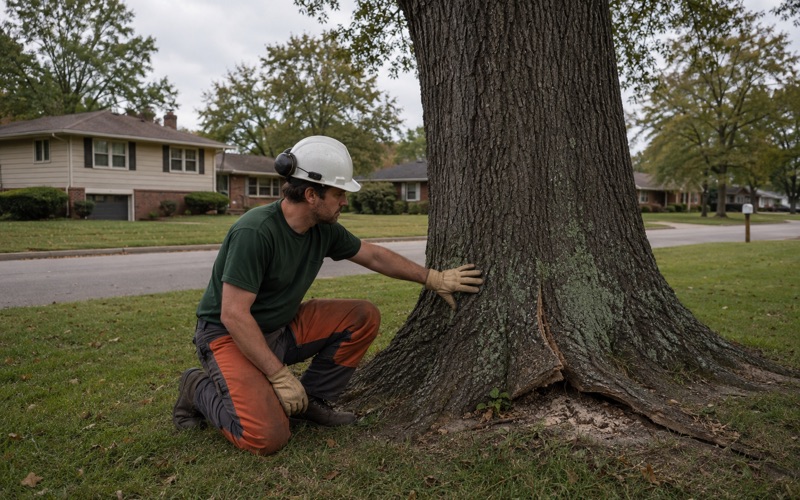
We check the root flare, look for a conk or a cavity at the base, note co-dominant stems with included bark, and mark the deadwood that comes out first. That read picks the method — a climb, a spider lift, or a straight fell where there is genuinely room — and it also decides whether removal is the right answer at all. Plenty of these trees are better served by crown cleaning or by cabling and bracing, and we will tell you when that is the case.
Looking for tree-removal closer to Spring Hill? See Spring Hill Tree-Removal.
Rigging down instead of felling on a narrow setback
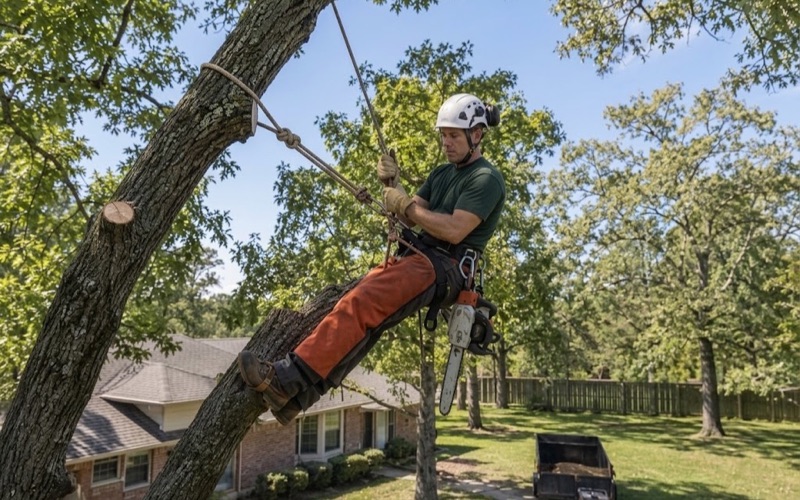
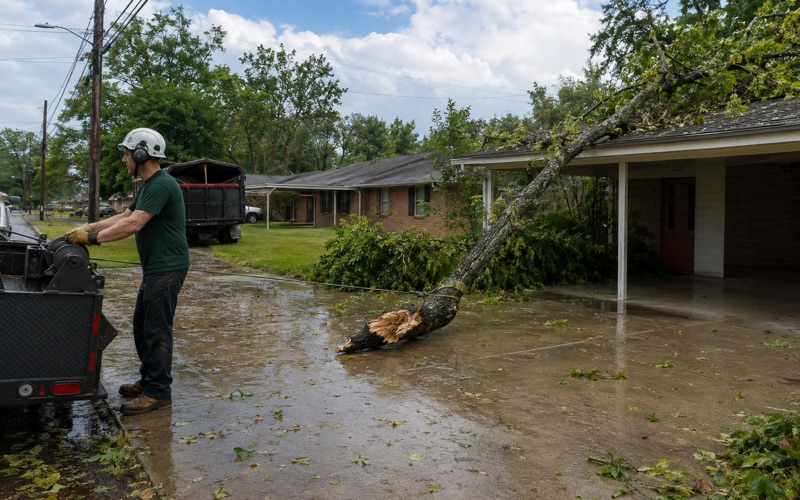
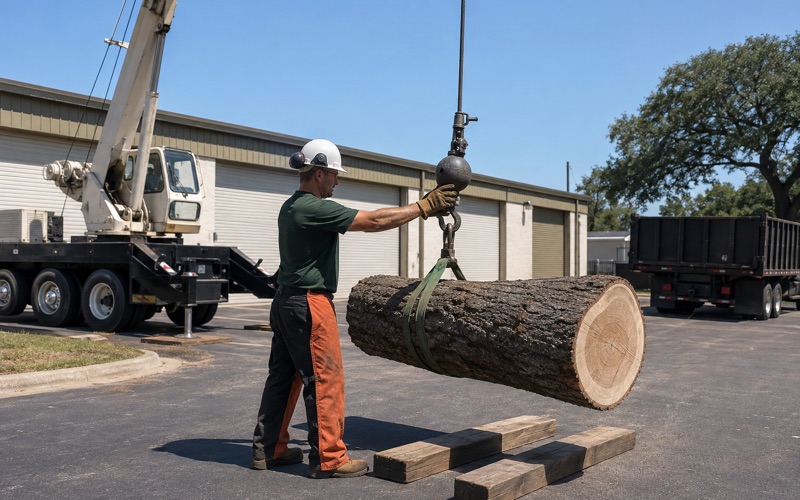
When the drop zone is short, the tree comes apart in controlled pieces instead of arriving all at once. That means a rigging block set above the cut, a bull rope run down to a friction lowering device at the base, and every piece sized against the working load limit of the weakest component in that system. It is slower than felling, and it is why a tree standing close to a foundation can still come down without touching it.
We work to the ANSI Z133 safety requirements on the ground and to the ANSI A300 cut types when a job turns out to be pruning rather than removal. We do not top trees. The ordinance agrees: damage or destruction of trees through excessive pruning or topping is written into it as a violation in its own right.
When a spider lift earns its keep
A spider lift is a tracked aerial platform that folds narrow enough to pass between a house and a fence, then sets outriggers and works from above. On a rear yard with new sod and irrigation under it, that beats walking a heavy truck across the grass, and it puts the whole workload onto a stable platform up in the crown. We spread outrigger loads on mats rather than trusting whatever the finished grade looks like.
What the machine is standing on
That last point carries more weight here than in most of our service area. Section 3.3.9 of the Town’s Land Development Ordinance opens with the words “Because of the history of phosphate and other mining activities within the Town,” and requires a developer to assess previously mined or disturbed ground and map it. Williamson County’s soil-mapping regulation makes the same warning from the other direction: a mixed soil area covering a large area is a sign of past mining, phosphate operations ran through the 1980s, and the mined areas shown in the 1964 county soil survey are not the only ones.
The same regulation names the other way ground gets mixed, which is land cleared by pushing up stumps and root balls with a bulldozer, plus back-filled pits. Buried wood, rubble and old fill are a live possibility on recently cleared ground, and they change what an outrigger pad or a grinder wheel is actually sitting on.
Working next to a lot that is still being built
A live build next door pushes on the job from two sides. Their crew, material stacks and parked equipment occupy part of the ground we would otherwise use as a drop zone, and our brush, chips and rounds have to come off a site that has rules about where anything may be set down.
Tree protection fencing is a boundary, not a suggestion
On an active site the trees a plan requires to stay are fenced at the critical root zone, and that tree protection fencing marks the edge of the Tree Protection Zone. We stay outside it: no brush piled inside the fence, no chipper parked on it, no rigging anchored to a protected trunk. Compaction and root damage inside that line count against the tree the same way a saw cut would.
Section 3.3.14 defines the Tree Protection Zone to include the critical root zone of every healthy retained tree, identified in a form the Town accepts — an open space lot, a deed restriction, a conservation easement or a dedication to the Town — and depicted on the plat, site plan or grading plan. No building may sit inside it. After a notice of violation, reviews and approvals of development permit applications for the site are stayed until a replacement plan and schedule are approved, so a tree problem stops a build.
The permit, and when you do not need one
No removal or disturbance of existing trees on a parcel or development site may happen before approval of a Tree Removal Permit, a Building Permit or a Land Development Permit. The Tree Removal Permit comes from the Town’s Department of Community Development and may be issued at the same time as a Land Development Permit. Removing a tree without one does not avoid the mitigation standards; it applies them after the fact instead.
The exemptions cover most ordinary homeowner work. Grubbing trees and woody brush of four inches DBH or less is exempt, as is removal of a tree that Town staff determine to be unhealthy, or one carrying written verification of a dead or dying condition prepared by a qualified arborist, or a nuisance tree, or one judged a threat to a structure, an underground utility or public safety, along with anything on the Tennessee Invasive Plant Council’s current invasive list.
Table 3-1 then sorts applicability by lot. A platted residential lot of one acre or less is subject to none of the canopy retention, existing-lot removal or specimen tree standards, house on it or not; a platted residential lot larger than an acre is subject to the removal and specimen standards, and no Tree Protection Zone is established on it. We read that table for the specific lot before quoting, because this service area crosses six counties and the answer changes at the line.
Putting the tree’s condition in writing
Where an exemption turns on a tree’s condition, the read needs to exist on paper. We write up what we found, in a form a homeowner can hand to the Town, to an insurer, to a neighbor, or to an HOA architectural review committee that wants a reason before it agrees to anything.
Getting the wood off the site, and what is overhead
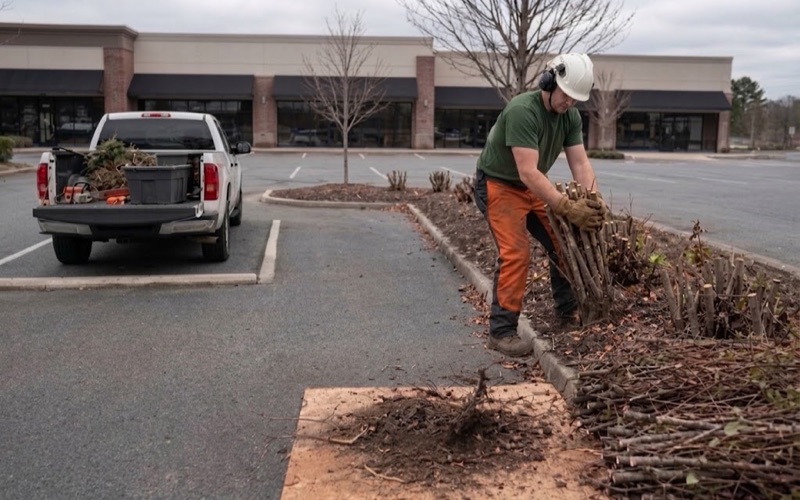
The Town provides no trash or brush service at all. Its own utilities page directs residents to their homeowners association or to the Williamson County convenience center next to Sarah Benson Park, which is free to county residents — and beginning May 4, 2026 that center accepts brush only in lengths of three feet or less. Nobody is self-hauling a trunk under that limit.
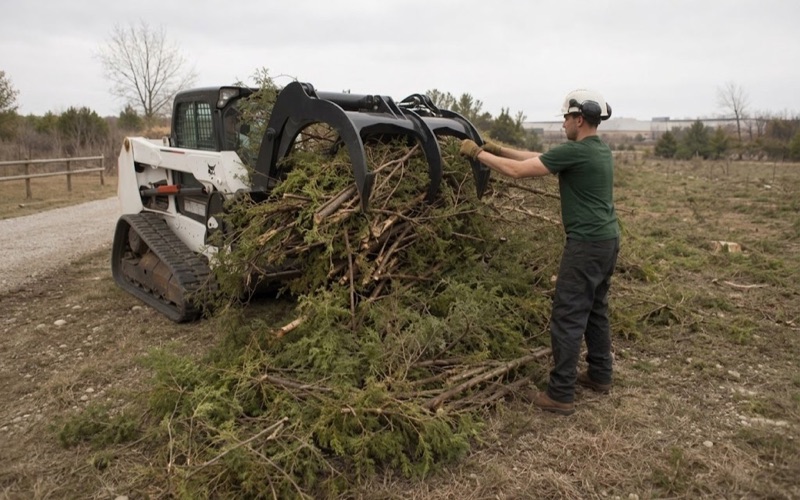
Haul-away is therefore part of the job here rather than something that can wait at the curb for the town. The Williamson County Landfill on Pinewood Road in Franklin takes brush at $40.00 per ton, and the county’s own page states that beginning May 4, 2026 there is no free disposal and all incoming loads are charged regular tonnage fees. We price disposal for the county a job actually sits in, since the gates across this service area do not all charge the same way.
Stump grinding and depth to rock
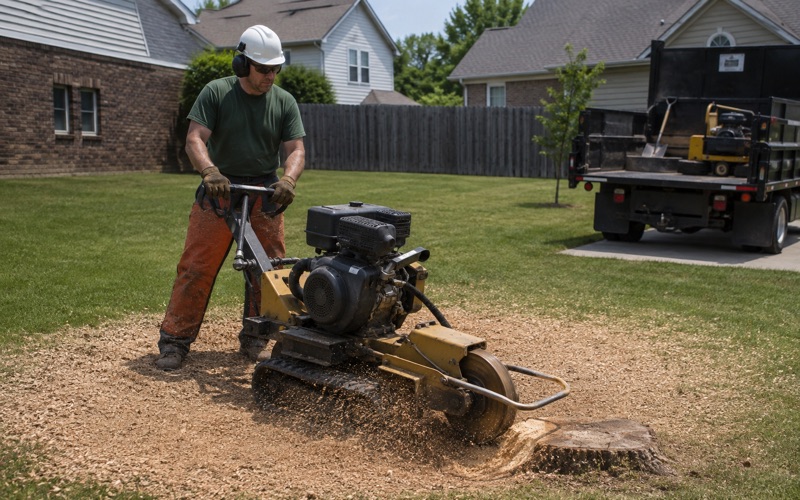
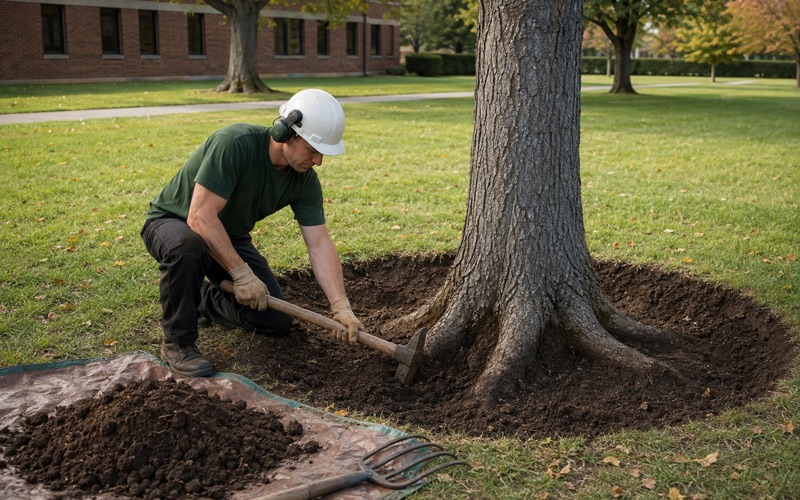
Depth to rock is a per-parcel number in Williamson County rather than a townwide one. The county’s soil-mapping regulation records it by soil series in inches — Talbott at 20 to 22 inches to rock on 0 to 5 percent slopes is one of its worked examples — and it names the awkward subsurface patterns outright, including pinnacle and trough rock and randomly buried floaters. A tracked stump grinder rated to cut 12 to 16 inches below grade lives comfortably inside that range, but we probe first rather than finding the ledge with the wheel.
Lines, transformers and ice
We confirm which electric utility serves an address before quoting work near a conductor. The Town’s utilities page names Middle Tennessee Electric Membership Corporation as the provider here, and MTEMC’s No Grow Zone rule asks for 12 feet of clearance in front of a pad-mounted transformer and 3 feet on its other sides, which is worth knowing before equipment goes near one in a front yard.
Ice, not wind alone, is the storm mode that makes failure work in this county. Winter Storm Fern arrived early on Saturday, January 24, 2026, produced close to 15,000 outages in Williamson County by the end of that weekend, and put trees and power lines across county roads. Loading like that finds the weak union and the included bark first, which is the argument for dealing with both on a scheduled visit rather than an emergency one.
- 20+ Years in Middle Tennessee
- Free Written Estimates
- ANSI A300 Pruning, No Topping