Smyrna Tree Removal has been handling tree removal in Spring Hill for more than twenty years, and the first thing we settle on a job here is which county the property actually sits in. The city limits cross a county line, and the two disposal gates behind that line charge on different scales for the same load of green wood. That one question moves the haul portion of a price before a saw ever runs.
Estimates are free, and the estimate is where the decisions get made rather than after the fact. If a tree is a candidate for pruning, cabling or bracing instead of coming down, we say so before we quote a removal.
Our service area crosses six counties, so we read the rules for the place a tree actually stands in rather than applying one rulebook everywhere. In Spring Hill that habit earns its keep more than usual, because two counties’ worth of rules apply inside one set of city limits.
One city, two counties, two disposal gates
Spring Hill sits in Maury and Williamson counties at the same time, roughly 30 miles south of Nashville, with about 29 square miles inside the city limits. A Spring Hill address is a Maury County address or a Williamson County address depending on which part of town it is in, and nothing on the mailbox announces which. For most of what a homeowner deals with the distinction never comes up; for moving several tons of wood off a lot, it is the whole question.
Where the wood goes on each side of the line
On the Maury County side, the county transfer station on Lawson White Drive in Columbia takes waste generated in the county at $78.00 per ton with a $25.00 minimum charge, and a business cannot simply drive in — the county wants a W-9, a certificate of insurance and a business license approved before it tips there at all. On the Williamson County side, the county landfill on Pinewood Road in Franklin takes commercial brush, clean wood waste and chips at $40.00 per ton.
Same crew, same saws, same tree, and the gate fee behind the job is not the same number. Williamson County has also announced that from May 4, 2026 there is no free disposal at its landfill and every incoming load is charged regular tonnage fees, with free disposal not resuming until January 2, 2027. We price the haul against the gate a job actually feeds, which is why we ask which side of the city you are on before we put a figure on the debris.
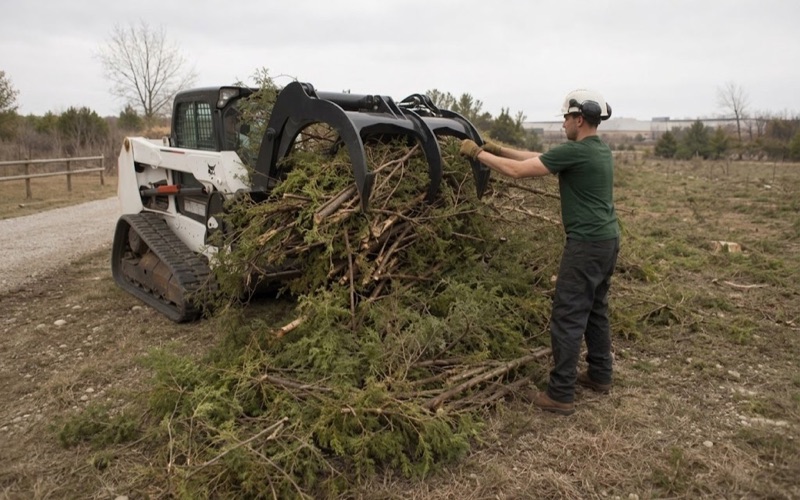
Volume is the other half of that arithmetic. A single large hardwood removal makes a load of rounds and chips that is measured at the scale house, so the gate fee is a line worth getting right, and we estimate the load before we price it.
What the city collects, and what it will not
The city’s sanitation policy is specific about this. Brush and limbs cut by the homeowner have to be under 10 feet long and at the curb by 6:00 a.m. on Tuesday, with collection running Tuesday through Friday and bad weather stretching it to two weeks. Contractors are required to dispose of their own debris, and the policy names tree limbs among the debris it means.
There is a second wrinkle in a city built largely of subdivisions. A property on a street listed as private on the final plat receives no city brush or bulky collection at all, and takes a $2.35 monthly credit on the sanitation bill instead. Either way, wood we cut leaves on our truck, and we say that at the estimate rather than letting anyone discover it on a Tuesday morning.
Looking for tree-removal closer to Goodlettsville? See Tree-Removal in Goodlettsville.
A canopy that arrived with the subdivisions
Of the city’s 20,536 housing units, 15,604 are single-family detached, and the build dates cluster hard in one direction: 7,294 units went up between 2000 and 2009, 7,801 between 2010 and 2019 and 1,835 in 2020 or later, against 238 dating to 1939 or earlier, 32 from the 1940s and 86 from the 1950s. Spring Hill is recognized by the U.S. Census Bureau as the fourth fastest growing city in Tennessee, and the trees on most of these lots arrived with the growth.
What that mix means in practice is that removals here are rarely about a dying giant. More often it is a tree planted too close to a foundation, a pair of stems that split in a storm, or a fencerow cedar left standing when the lot was graded.
What actually grows here
The natural woods of this part of the Outer Nashville Basin run to white oak, southern red oak, black oak and scarlet oak with shagbark and pignut hickory, and to yellow poplar, red maple, sugar maple, black walnut, elm and hackberry on the cooler, moister slopes. Eastern redcedar is the species that colonizes thin residuum over limestone and takes over an unmown pasture, so clearing a Spring Hill lot back to usable ground is more often a cedar job than a hardwood one.
Planted stock is a separate problem. Subdivision landscaping leans on fast ornamentals, and Callery pear in particular puts up a crowd of co-dominant stems with included bark at the unions, so its failure mode is a stem tearing out of the trunk under load rather than a tree slowly dying.
Shallow soil and wide root plates
The ground under all of it is clayey residuum weathered from limestone. A Mimosa profile carries 40 to 60 inches of soil with bedrock at about 55 inches; a Talbott profile puts hard limestone only 20 to 40 inches below grade. A tree that cannot root past that rock spreads a wide, shallow root plate instead of going down.
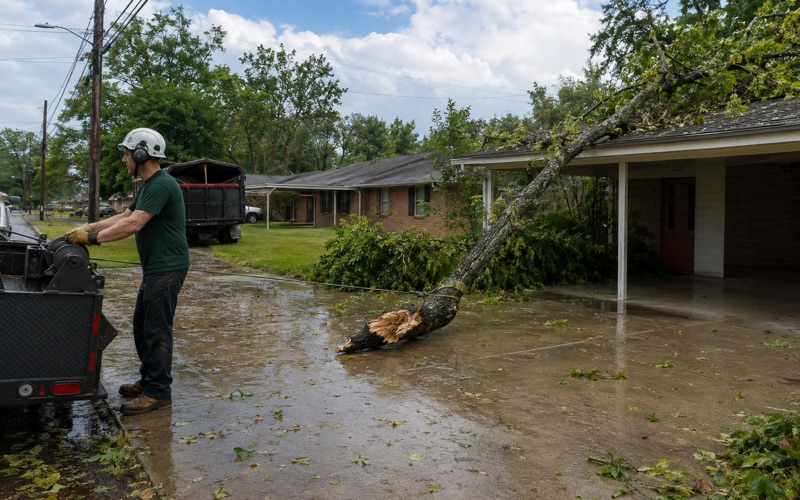
That is the windthrow mechanism here, and ice is what loads it. The January 2026 storm laid half an inch of ice or more across Middle Tennessee, and on saturated ground a plate carrying that weight lifts as one piece rather than the stem breaking. When a tree comes over that way, we will give you a straight answer on whether the job is worth an insurance claim.
Maintaining a young canopy instead of removing an old one
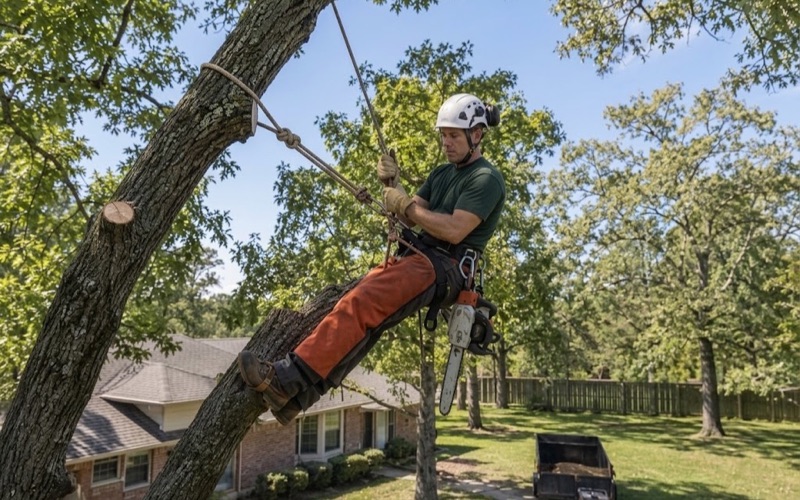
Most of what these lots need is not removal. Pruning worked to the objectives and cut types the ANSI A300 standard defines — crown cleaning, crown raising, a reduction cut where a limb has overextended — is what keeps a twenty-year-old shade tree from turning into a thirty-year-old liability. We do not top trees.
On a lot this young the annual work is usually deadwooding and light crown thinning, not a rescue. Getting the structure right while a tree is still small is what decides whether it ever becomes a removal at all.
Structural work is also cheapest early. Reducing one of a pair of co-dominant stems while they are still small is a pruning cut; the same defect left alone becomes a cabling and bracing question, with extra high strength cable or a brace rod through the union. We will tell you which of those a tree is a candidate for, and put it in a written tree condition report you can hand to a neighbor, an insurer or an HOA architectural review committee.
Lines, gates and access
Three electric utilities serve parts of this city — Middle Tennessee Electric, Columbia Power and Water Systems, and Duck River Electric Membership Corporation — and the city itself tells residents to read their bill to find out which one is theirs. We check that before quoting anything near a conductor. Middle Tennessee Electric maintains a 40-foot right of way, 20 feet on each side of a line, and its own vegetation management crews cut back or remove trees inside it, which sometimes means the tree you called about is not ours to touch.
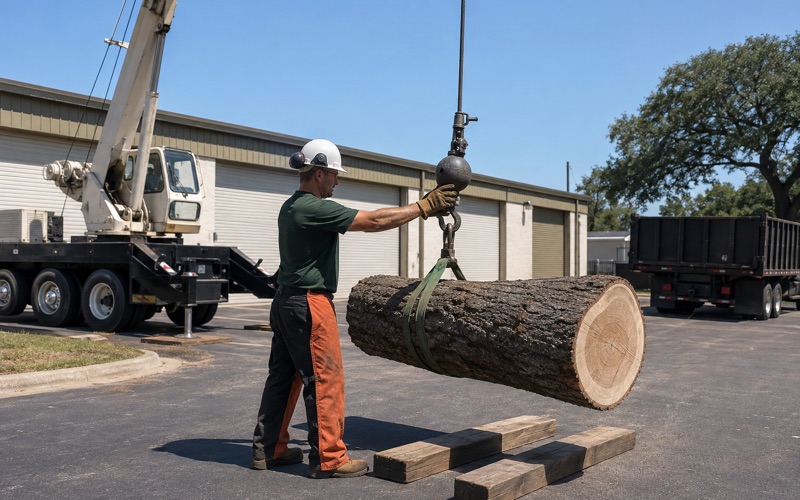
Access is the other subdivision constraint. Compact tracked equipment fits through a standard back-yard gate, so a rear-yard removal on one of these lots rarely has to become a crane job.
What we establish about a lot before quoting the haul
Before a price goes on paper we settle four things: which county the property falls in, whether the street is public or platted private, which utility owns the wire, and how deep the soil runs where the stump is. None of the four is guesswork, and each one moves a number on the estimate.
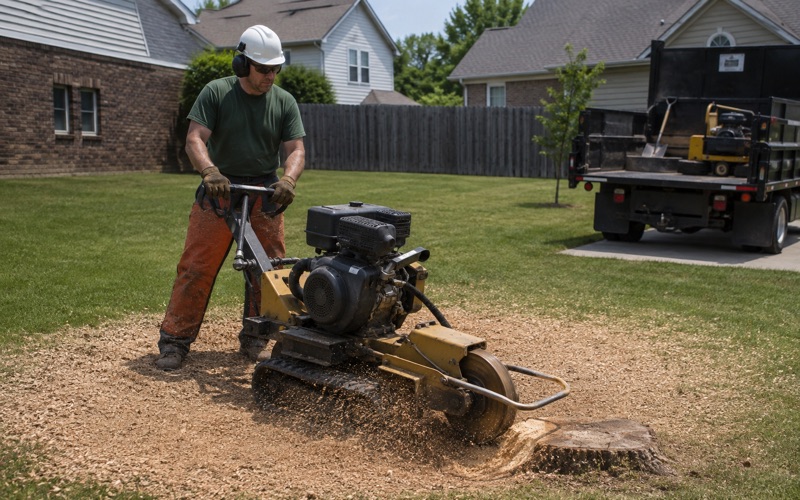
That last one is not a formality. A tracked stump grinder rated to take 12 to 16 inches below grade is working in soil on most lots; asked to chase a large root plate on a Talbott profile, it is working toward rock. We would rather the bid say so before the wheel is on site than renegotiate in the middle of the job.
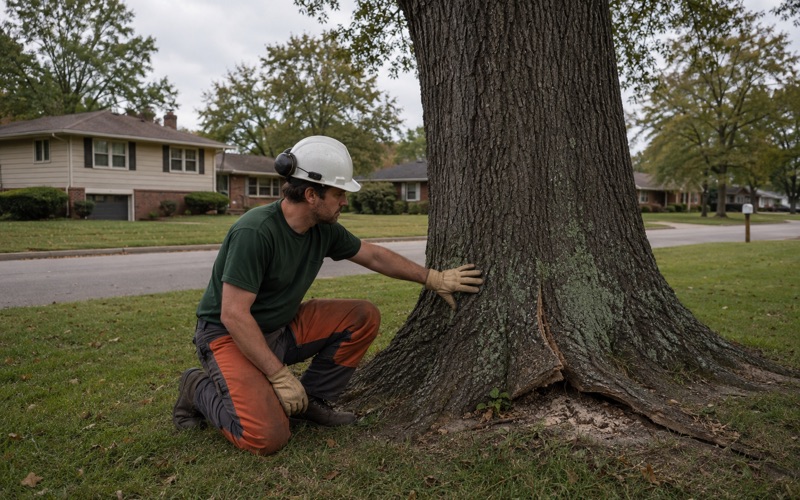
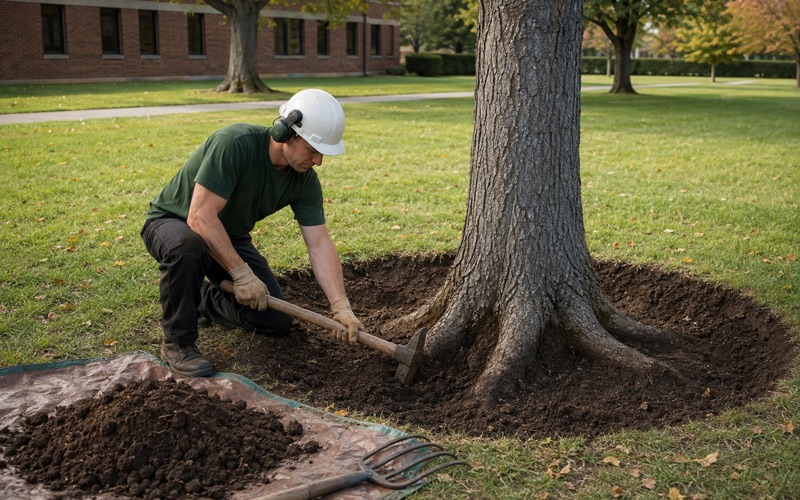
The walk-around itself is a tree risk assessment rather than a glance from the driveway. We measure diameter at breast height, clear the leaf litter off the root flare to see whether the collar is buried, and look for conks, cavities and cracked unions. What we find there decides whether we are quoting a removal, a crown reduction or nothing at all.
What the written estimate names
The estimate lists the inclusions rather than implying them: the trunk rounds, the stump, the grindings and the chips, and which of those stay on site and which leave. The disposal line names the gate the load is going to, because in this city that is a genuine variable rather than a rounding error.
On licensing, plainly
Tennessee does not issue a trade-specific tree care or arborist credential, and the state contractor requirement attaches at $25,000 or more in materials and labor. The county-option Home Improvement law has been adopted in nine Tennessee counties, and neither Maury nor Williamson is among them, so it does not reach work done inside this city. Ask any company you talk to what coverage it actually carries, and get the answer in writing.
- 20+ Years in Middle Tennessee
- Free Written Estimates
- ANSI A300 Pruning, No Topping