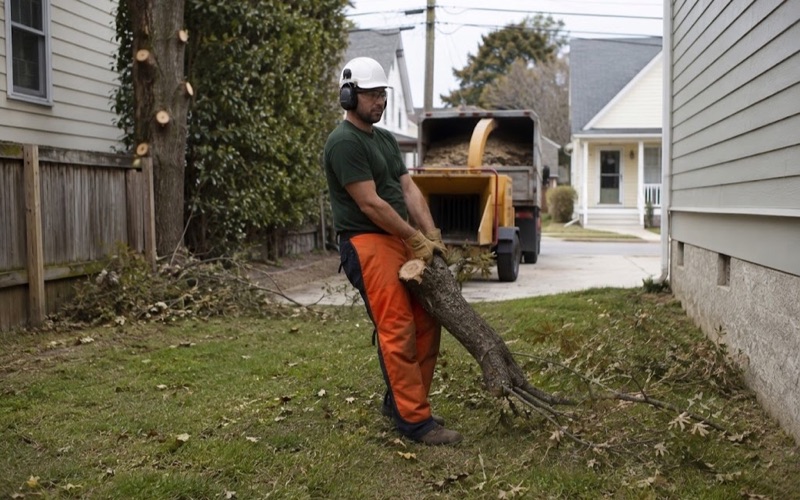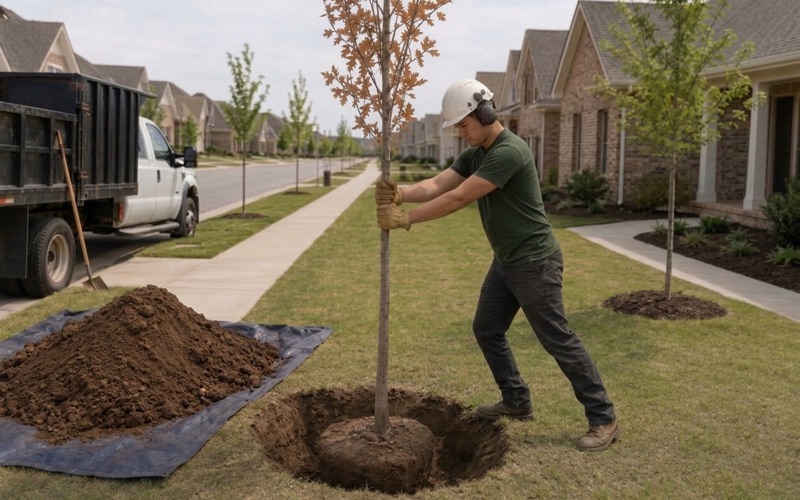
Smyrna Tree Removal has handled tree removal in Shackle Island for more than twenty years, and the first thing we settle on any job here is which office actually has a say over it. Shackle Island is unincorporated, so there is no city hall to call and no municipal code to read. Sumner County is the whole government layer standing over the tree in your yard.
That matters less than homeowners expect on a settled lot and more than a builder expects on raw ground. We found no county requirement for a permit to take a tree off an existing developed single-family lot here, and no protected or heritage tree designation covering the community. Where the county does speak is on land being subdivided, and there the rule is strict.
Our service area crosses six counties, and the answer to the same question changes at every line. We read the rules for the jurisdiction the tree actually stands in before we quote, rather than carrying an assumption over from the last town. On this side of the line that means county subdivision regulations, the county engineer, and a disposal gate that charges by the ton.
The county is the only tree layer over Shackle Island
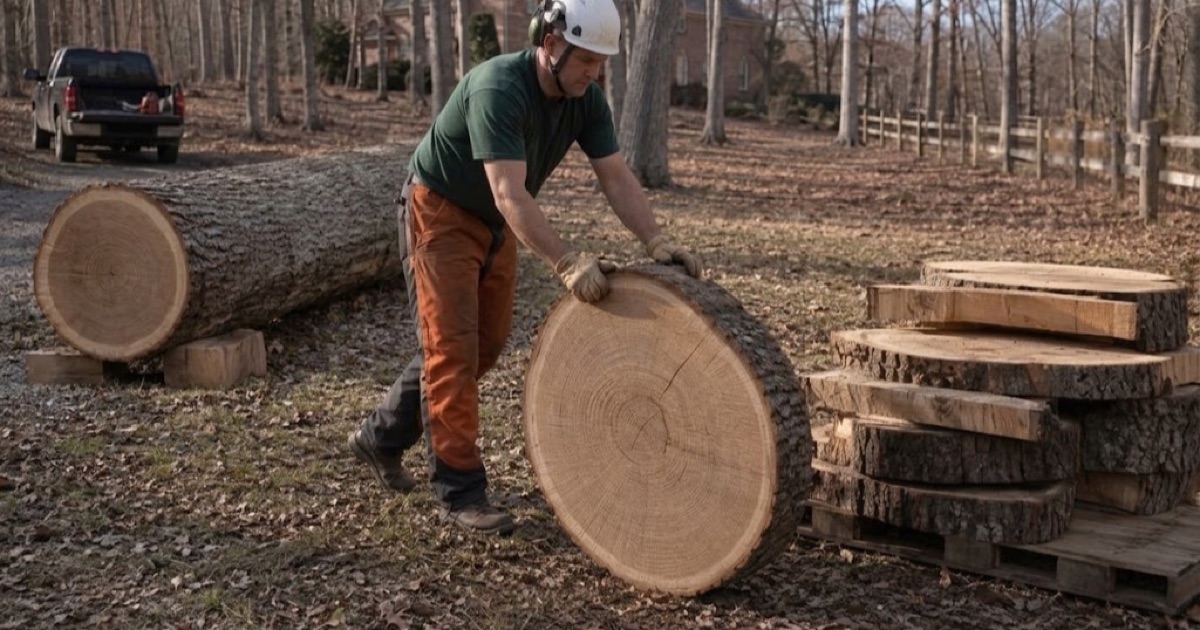
Because the community is unincorporated, there is no city charter, no city zoning ordinance and no city building department standing between a homeowner here and a tree. The Sumner County Planning and Engineering Department on North Belvedere Drive in Gallatin enforces the county Zoning Resolution, the Subdivision Regulations and the Stormwater Management Resolution, and it evaluates applications for new construction across unincorporated Sumner County. Every land use and permitting question a municipality would answer somewhere else is answered there.
One office to ask, one set of documents to read
We treat that as a simplification rather than a gap. There is a single set of documents governing a Shackle Island address, and we check it against the parcel before a quote goes out instead of assuming the last job’s rules travel four miles up the road. If a crew tells you a permit is required here without naming the resolution and the article that requires it, that is worth a second question.
A settled lot is a different question from raw ground
On a developed single-family lot with a house already on it, no county provision requiring a permit to remove a tree turned up, and no protected, heritage or landmark designation applies in this community. What usually governs a removal on that kind of lot is the tree’s own condition and where it stands relative to a property line. Under Tennessee law an encroaching branch or root becomes a nuisance only when it causes actual harm or poses an imminent danger of it, and a neighbor’s self-help right otherwise stops at the property line.
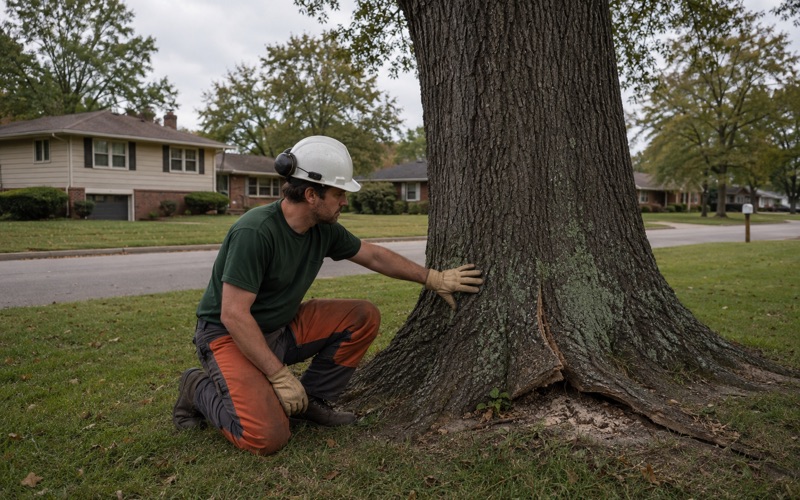
We write tree condition reports for exactly that conversation, so a homeowner has something to hand a neighbor, an insurer or an HOA review committee instead of repeating an opinion secondhand. A report puts the defect, the target and the reasoning in one place. It is also what we would want in hand before anyone spends money on a tree that may not need to come down.
Looking for tree-removal closer to Gallatin? See Gallatin Tree-Removal.
Nothing is cleared before the plat is approved
The one rule in this county that directly restrains cutting trees is triggered by development, not by ownership. Article II.H.1 of the Subdivision Regulations of Sumner County, headed Limitations on Grading Activities, provides that no grading or clearing of trees may be undertaken in any form before the Planning Commission approves a Preliminary Plat and Construction Drawings, excepting only what is required to facilitate surveying. A crew working ahead of a builder on a platted subdivision sits squarely inside that rule; a crew taking a hackberry out of a back yard on an established street does not.
The sequence a site-clearing crew works behind
The same regulations withhold a land disturbance permit until the County Engineer has approved a set of Construction Plans, and no Final Plats are considered for approval before that approval exists. That fixes an order of operations, and the order of operations is the schedule. The Sumner County Regional Planning Commission reviews the applications, holds the hearings, and grants or denies the Preliminary Plat and Construction Drawings approval that releases grading and tree clearing.
A homeowner who has just closed on a lot in a new section sometimes reads that rule as a ban on touching anything. It is narrower than that: it constrains grading and clearing while a subdivision is being brought through approval, and it lifts once the Planning Commission has signed off on the plat and the drawings. We ask where a parcel sits in that sequence because the answer decides whether we work today or after the next commission meeting.
What we ask before we mobilize on a development job
Before we put a machine on ground that is being subdivided, we ask which approvals are on file and where the land disturbance permit stands. It is a short conversation that keeps a stem from coming down a week early. Where trees are meant to survive the build, we set tree protection fencing at the tree protection zone first, because construction traffic over the root plate is what actually kills a saved tree.
No municipal brush pickup, and no city crew after a storm
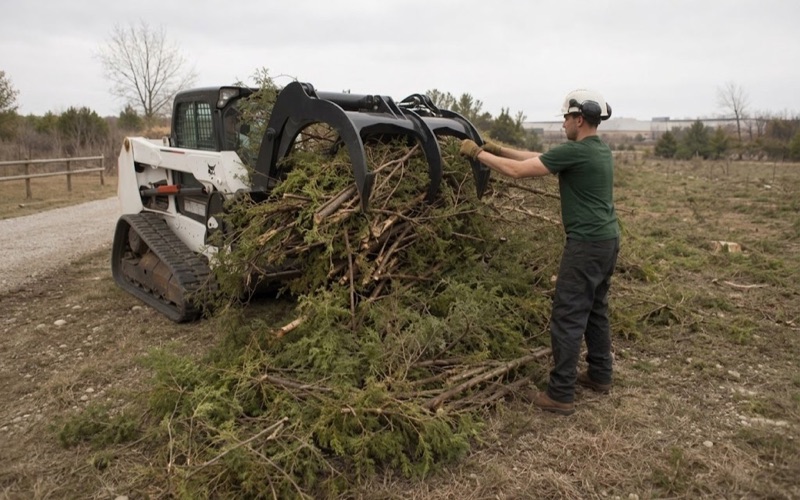
There is no free curbside limb collection here and no residents-only drop-off, because there is no municipality to run one. Debris from a Shackle Island job goes to the Resource Authority in Sumner County, which charges $45 per ton for yard waste, brush and clean untreated wood with a $10.00 minimum, and takes construction and demolition debris at $85 per ton. Its scale runs Monday through Friday from 6:00 a.m. to 4:00 p.m. and Saturday from 6:00 a.m. to 2:00 p.m.
We say that up front rather than leaving a pile at the curb for a collection that is never coming. The haul is ours, and we price disposal for the county the job is in, since the gates here charge by the ton and the next county over charges by the cubic yard. The inclusions go in writing before we start: the trunk rounds, the stump, the grindings and the chips.
After a big wind, the queue is long
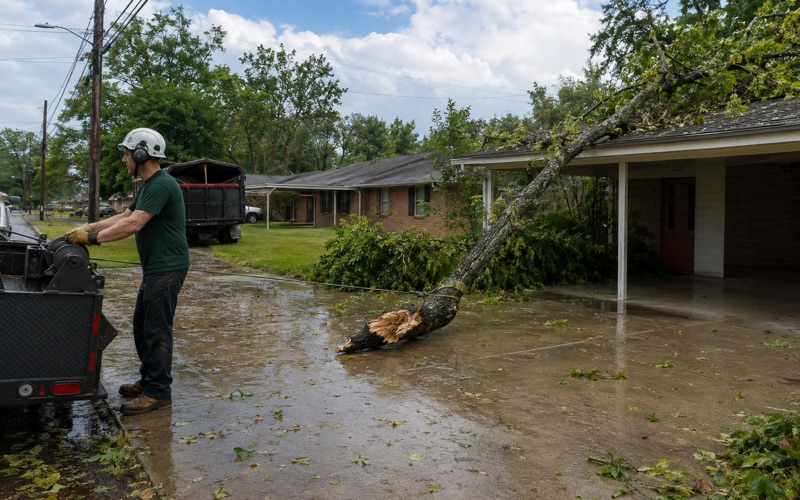
Fire and emergency medical response in this community comes from the Shackle Island Volunteer Fire Department, which has served the area since 1989 and is entirely volunteer. That is the local capacity a tree-on-structure call draws on, and it is worth knowing before a storm rather than during one. The derecho of June 21, 2019 was the most widespread damaging wind event to hit Middle Tennessee in at least fifteen years, damaging poles and lines and causing more than 100,000 outages, some of them lasting up to a week.
Ice is the other load that brings this canopy down, and the storm of January 24 and 25, 2026 was described as the worst in decades for Middle Tennessee, with debris volumes running far above normal for months afterward. We plan storm work around the wind, tornado and ice loading this region actually records rather than a generic script. The Nashville office of the National Weather Service counts an average of about 10 tornadoes a year across Middle Tennessee over its 1950 to 2025 record, and about 18 a year over the shorter record since 1995, which are climatological counts rather than a forecast.
An owner-occupied, detached community on Drake’s Creek
The housing here is almost entirely single-family and almost entirely owned: 1,498 of the 1,502 housing units are one-unit detached houses, the remaining four are mobile homes, and none sit in a structure of two or more units. Owner-occupied detached houses number 1,393, which is 92.7 percent of occupied units. The median unit falls in the 1990 to 1999 band, also the largest single decade cohort at 387 units, while 366 units, or 24.4 percent, date to 1979 or earlier.
That mix describes the trees we are called out to. A yard planted when the house went up in the 1990s is carrying canopy over a roofline now, and the older quarter of the stock carries the mature stems. Compact tracked equipment fits through a back-yard gate on lots like these, which keeps a subdivision removal from having to become a crane job.
What the ground does to a stump grinder
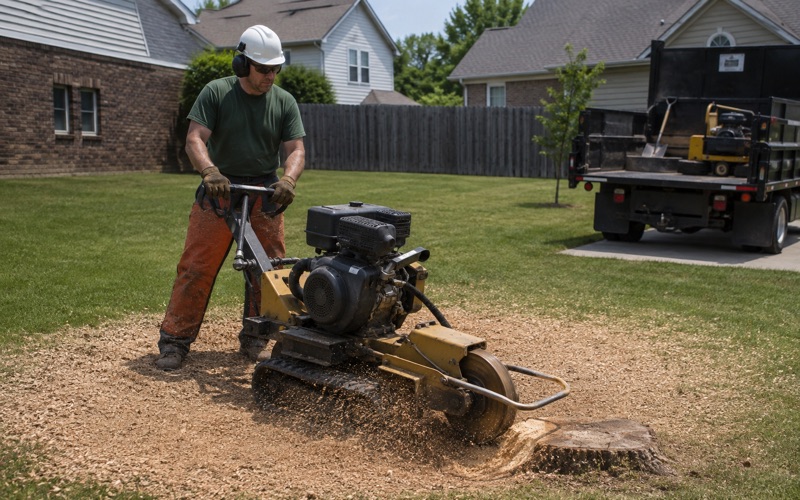
Shackle Island sits in the Outer Nashville Basin, and the soils mapped there run deep. Mimosa is 40 to 60 inches to rock, Dellrose more than 60 inches, and Armour more than five feet to limestone bedrock. A tracked stump grinder cutting 12 to 16 inches below grade reaches its own mechanical stop long before it reaches rock, so refusal on stone is rarely what ends a grind here.
What wears a wheel instead is chert volume. Dellrose carries 10 to 35 percent chert fragments in each horizon above the discontinuity and as much as 50 percent in the lower Bt horizon, and it occupies foot slopes and hillsides at slopes dominantly 12 to 40 percent. We plan teeth and grinding time around that, and we plan access around the slope it sits on.
Canopy, creek banks and the line overhead
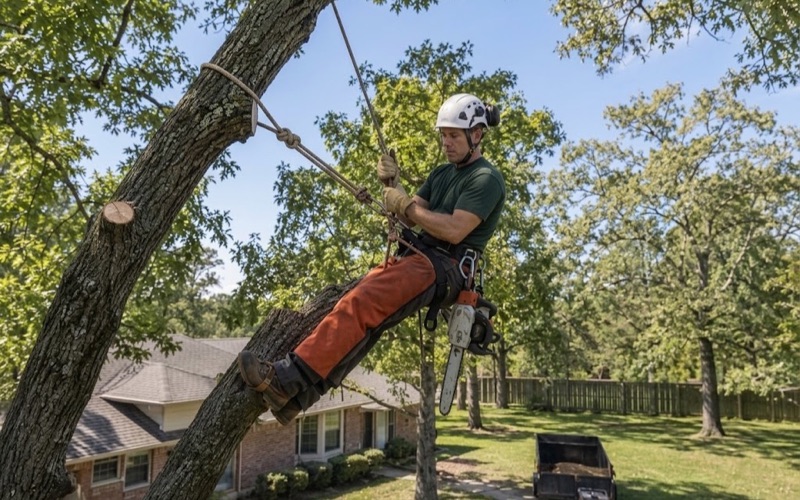
The forest this ground supports is oak-hickory grading toward mixed mesophytic, so white oak, northern red oak, tulip poplar, the hickories and sugar maple are the stems we remove most often. Drake’s Creek, which historically split into two channels that rejoined and made the island the community is named for, runs south toward the Cumberland and gives a number of lots a creek bank and a riparian canopy that behaves nothing like an open yard. A leaning stem over a bank gets rigged down rather than felled.
Ash is the one species we push people to decide on rather than watch. Emerald ash borer has been established in Tennessee since 2003 and kills a large ash within about three years, and dead ash goes brittle quickly enough that a routine removal turns into a rigging problem if it waits. We would rather look at a declining ash while it can still be climbed.
Cumberland Electric Membership Corporation distributes power across Sumner County and keeps a 20-foot right-of-way clearance on both sides of its lines, with clean-up included in that vegetation work. The tree itself remains the member’s property, and CEMC asks a member to call and set up a service order so the service line to the house can be dropped before pruning or removal starts near it. We confirm which utility serves an address and get that service order moving before we quote work near a line, because assuming is how a crew ends up standing in a yard waiting on a truck.
- 20+ Years in Middle Tennessee
- Free Written Estimates
- ANSI A300 Pruning, No Topping