Smyrna Tree Removal has been doing tree removal in Nolensville for more than twenty years, and on most jobs in this town the first question is not which saw comes off the truck. It is whether the tree stands on a lot somebody already lives on, or on ground a builder has not broken yet.
That line decides everything after it. Nolensville’s tree provisions attach to development: site plans, subdivisions, and the grading permit that lets a machine touch the dirt. On a parcel headed for construction the trees are inventoried, protected and replaced under a code section with hard numbers in it. On a finished residential lot in a settled subdivision the rules are triggered by development rather than by ownership, and no provision requires a town permit before a homeowner takes down a yard tree.
We read the ordinance for the town the tree actually stands in rather than carrying one rulebook across a service area that crosses six counties. In Nolensville that means reading a drawing somebody else stamped before we price a single stem.
The stamped tree survey a builder actually works from
On development work here the tree survey is not ours to make. Zoning Code Appendix B, Landscaping, Buffering and Tree Protection, and Appendix C both require the landscape plan to be prepared by a licensed landscape architect, and that plan is what a removal crew works from: a drawing with every qualifying tree already located, measured and graded for condition. Our part is to walk the site against the sheet and tell the builder where the two disagree, before the machines are staged rather than after.
Every tree of five inches and over, measured and located
Ordinance 22-10 lowered the inventory threshold from eight inches to five. The plan has to give the species, the size at diameter at breast height and the location of every existing tree of five inches DBH or greater inside an area to be disturbed by construction, measured four and one-half feet above natural grade. It also has to record each tree’s health as poor, fair or good, with contact information for the professional who made that determination.
Five inches is a small tree. Dropping the threshold by three inches pulls a great many understory stems onto a sheet that an older plan would never have shown, and the species column fills with the signature hardwoods of the Outer Nashville Basin: white oak, northern red oak, tuliptree, sugar maple, hickory, eastern redcedar, black locust and honeylocust, growing over phosphate-rich limestone residuum.
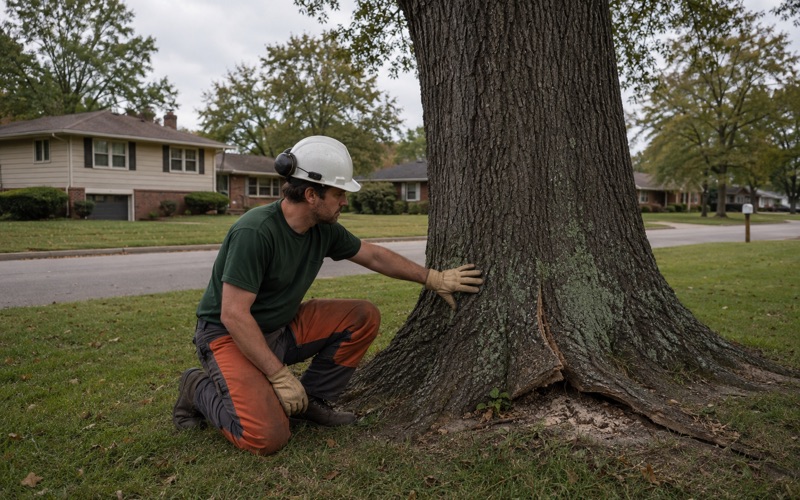
The condition column is the one worth reading closely, because poor, fair and good are the words a whole removal argument gets built on later. When we check a drawing against the trees actually standing, we are looking at whether the root flare is buried under fill, at co-dominant stems with included bark at the union, at conks on the trunk or out at the base, and at how much deadwood sits in the upper crown. Those findings are what separate a five-inch stem worth fencing off from a twenty-inch one that is a liability whether it stays or goes.
The stems that are not coming out
All trees of twenty-four inches or greater must be preserved, if possible, on single-family and non-single-family development alike, and existing tree coverage serving as a buffer may not be disturbed at all. Where the tree provisions conflict with anything else in the Zoning Code or the Subdivision Regulations, the ordinance states that the provision requiring greater retention of mature trees applies.
That is why tree protection fencing belongs up before the first pass rather than after. A protection zone driven through during grading is not something a later planting repairs, and it is exactly what the inspection at the end of the job is looking for.
Looking for tree service closer to Murfreesboro? See Murfreesboro Tree Service.
Replacement counted caliper for caliper
Absent Planning Commission approval, Title 6, Subsection 6.1.4(D) sets replacement at two inches of caliper planted for every one inch removed. A removed tree of five to ten inches caliper must be replaced with a tree of at least two inches caliper, and a removed tree greater than ten inches caliper with a tree of at least five inches caliper. The minimum sizes are floors on the individual replacement stock; the two-for-one arithmetic is what sets the total.
The removal decision is a planting decision
Once caliper-for-caliper replacement is in the code, choosing to take a tree out is choosing to buy nursery stock. A twelve-inch stem is not one tree to replace, it is twenty-four inches of caliper owed, in trees of at least five inches caliper each. We say that during the estimate, because the number a builder actually budgets against is the removal and the replanting together, and those two sit in different line items.
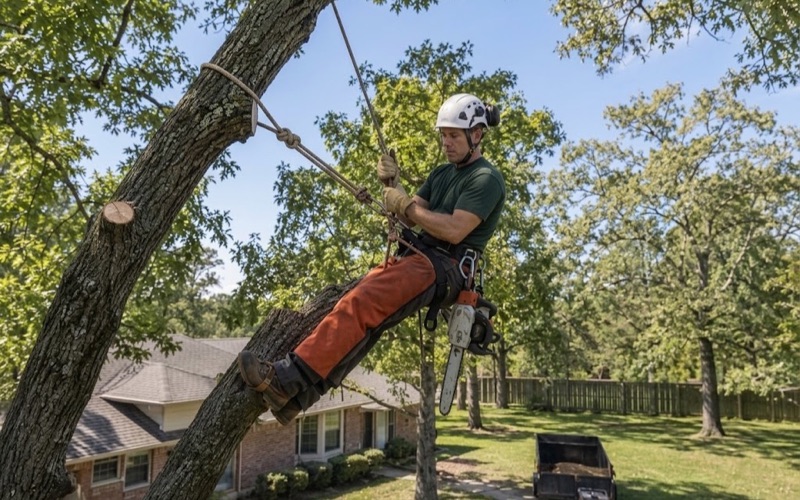
It is also why we will tell you when a tree can be cabled, braced or pruned instead of removed. Retention is worth more here than it is in a town with no replacement ratio. Pruning we do is worked to the objectives and cut types the ANSI A300 standard defines, and we do not top trees.
Who can vary the ratio
The Nolensville Planning Commission reviews and approves site plans and subdivisions, and it holds the discretion to waive or vary the replacement ratios. The Board of Commissioners at 7218 Nolensville Road adopts and administers the zoning code those standards live in and issues the grading permits they attach to; the town has operated under a manager-commissioner form of government since 2020. Which body you ask is not a detail, and a request to vary a ratio belongs with the commission that reviews the plan.
Paying into the Tree Save account instead of planting
A developer may pay the estimated cost of the required two-inch-or-greater caliper trees into a Tree Save account held by the Town instead of planting them, and the Town spends that money on buffering and screening plantings elsewhere. It sits in the same subsection as the ratio, which gives a site that cannot physically absorb its own replacement stock a route that does not involve crowding new caliper onto ground with no room for it.
There is a second way money reaches that account, and it is the one worth avoiding. Removing a tree in violation of the terms of a grading permit carries a five hundred dollar fee for each tree, paid into the same account. On a parcel where preserved stems stand inside a work zone, that fee is the price of one operator misreading a flag.
Which route a developer takes changes the question that reaches us. Where the replacement stock has to go back into the ground on the same site, the conversation is about which stems can be kept so the planting obligation stays small enough to fit. Where the money is going into the account instead, the conversation turns to access, staging and how much wood is leaving. We would rather know which of the two we are quoting before we walk the parcel.
What we put in writing before we start
Because the money rides on exactly which stems come out, we put the inclusions in writing first: the trunk rounds, the stump, the grindings and the chips, and which tagged trees the price covers. Written tree condition reports are available as well, the kind a homeowner can hand to a neighbor, an insurer or an HOA architectural review committee, and the kind that files next to a landscape architect’s plan on a builder’s job.
After the grading, somebody comes to check
Before a grading permit issues, the applicant pays for a third party the Town hires to inspect the site after grading and confirm that no tree designated as preserved was removed. The money is committed at the front of the job and the inspection happens at the back of it, so the record of what was supposed to survive is fixed long before anyone walks the site to compare it against what did.
We work to that record. Stems marked to stay are protected and left alone, and stems coming out come out cleanly. Nothing on the drawing gets revised in the field to save an afternoon.
What the ground does to a stump grind
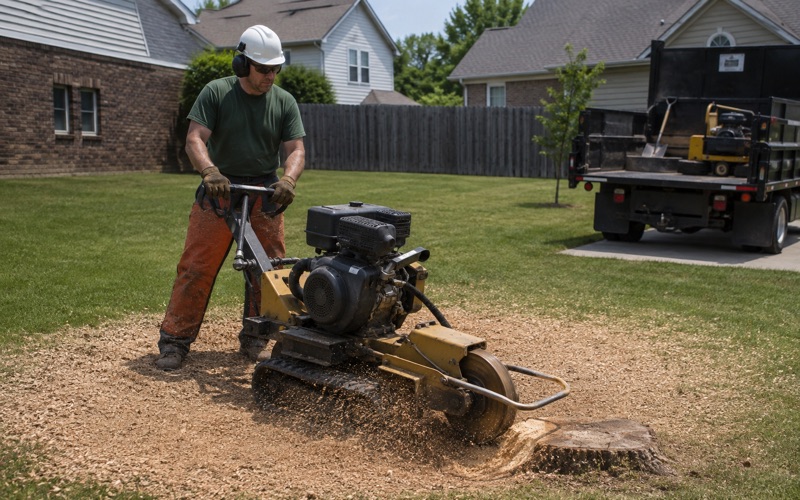
On the flat ground along Mill Creek the working soils are the deep valley and terrace series. Armour silt loam is well drained and fine-silty, formed in old alluvium, valley fill, or alluvium over limestone residuum, with bedrock more than five feet down. On the limestone uplands it reverses: Talbott is formed in clayey residuum weathered from limestone and runs twenty to forty inches to bedrock. A tracked stump grinder set to cut twelve to sixteen inches below grade is in soil the whole way on an Armour terrace and can be into weathered limestone on a Talbott upland, the same machine on the same quoted job having a different afternoon depending on where the lot sits. Bodine, the most extensive series mapped in Williamson County by acreage, carries thirty-five to eighty percent chert fragments through the particle-size control section, and chert in that volume is what dulls a grinder wheel, not the depth to rock.
Our compact tracked equipment fits a back-yard gate, so a tree behind a finished house does not have to become a crane job.
Where the wood goes
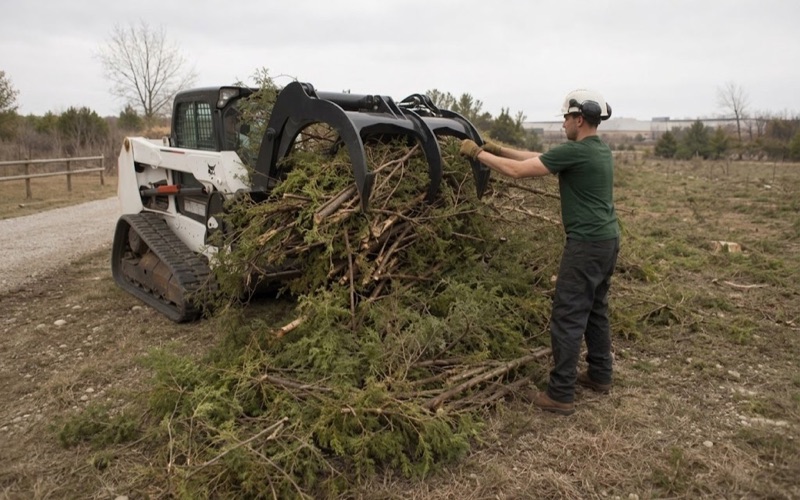
Brush and clean wood from a job here go to the Williamson County Landfill, operated by WM, or to the county convenience centers; the Town runs no landfill of its own. Brush delivered to a convenience center has to be three feet in length or less. Free disposal at the landfill is suspended from May 4, 2026 until January 2, 2027, with all incoming loads charged regular tonnage fees, so on this side of the service area disposal is priced by the ton while a gate in the next county charges by the cubic yard. We price disposal for the county the job is in, and we haul contractor-cut brush ourselves rather than leaving it stacked for a collection that is not coming.
One more check runs before we quote anything near a line: which utility serves the address. Middle Tennessee Electric is the provider the Town directs residents to, and MTE clears a forty-foot right of way, twenty feet on either side of the line, cutting back or eventually removing the trees standing inside it. Work in that corridor belongs to the utility’s line clearance program, and establishing that first keeps a builder from paying to have it done twice. Estimates are free, and if a stem on the inventory is better kept than replaced, we will say so while it is still standing.
- 20+ Years in Middle Tennessee
- Free Written Estimates
- ANSI A300 Pruning, No Topping