Smyrna Tree Removal has handled tree removal in Mount Juliet for more than twenty years, and on nearly every job here the conversation arrives at the same practical question: who takes the wood away. The city runs a chipper service plenty of residents have used for their own storm limbs, and it works well — but it stops short of anything a hired crew produces. Settling that before the price is written is the difference between a clean quote and an argument at the curb.
The trees themselves are the second thing worth stating plainly. Most of the canopy over Mount Juliet’s streets went in with the subdivisions, as nursery stock planted around new houses rather than woods left standing when the lots were cut. That changes what a removal looks like, what a stump costs, and which trees are worth saving instead of taking down.
We put the inclusions in writing before we start: the trunk rounds, the stump, the grindings and the chips, and the haul-off the city will not do for us. Estimates are free, and we will tell you when a tree can be pruned, cabled or braced rather than removed.
A canopy that was planted, not left behind
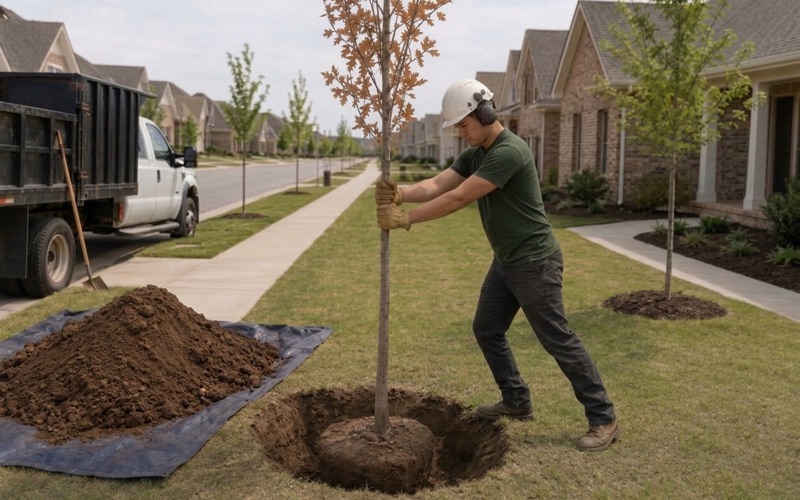
Just 1.1% of Mount Juliet’s housing units were built before 1960 and 8.9% before 1980, with the median construction band falling in 2000-09. Roughly 10,517 of its owner-occupied homes are one-unit detached houses, and the yard trees around them were set out with those houses. This is young canopy in the literal sense, and it behaves differently from timber.
Subdivision stock, and the defects it grows
A landscape tree planted in open lawn grows with no competition for light, which produces a wide low crown and, very often, two leaders where a forest-grown tree would have one. Co-dominant stems with included bark pressed between them are the classic failure point on this kind of tree: the union looks sound, and it splits in a wind event with no decay anywhere in the stem.
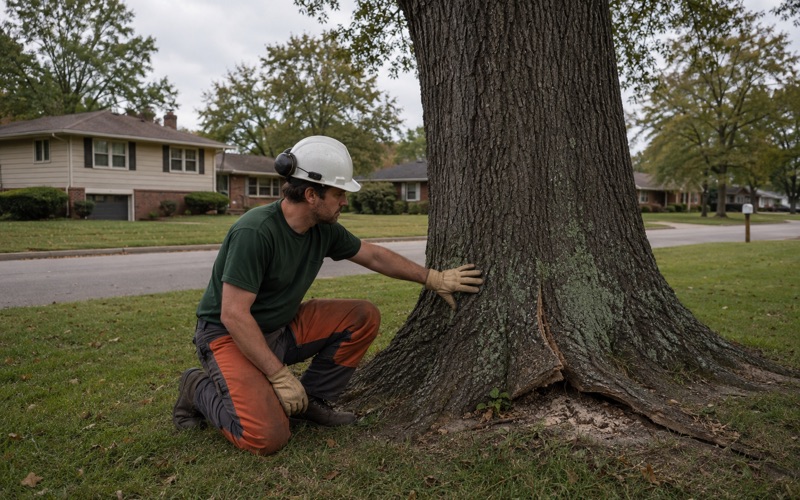
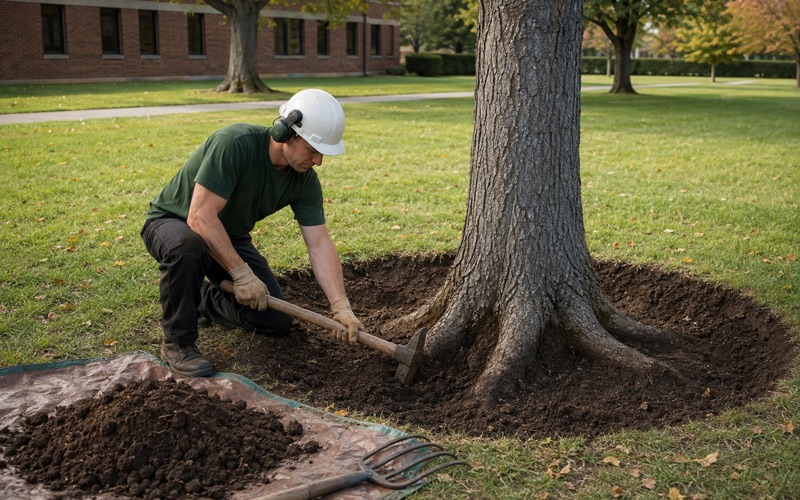
Callery pear and Leyland cypress turn up constantly in stock planted with these subdivisions, and both fail predictably — the pear at the union, the cypress from the inside once it thins. We look at the root flare before anything else, because a tree planted too deep or mulched over the collar has its problem below grade, where no amount of crown work reaches it.
The equipment a young lot actually needs
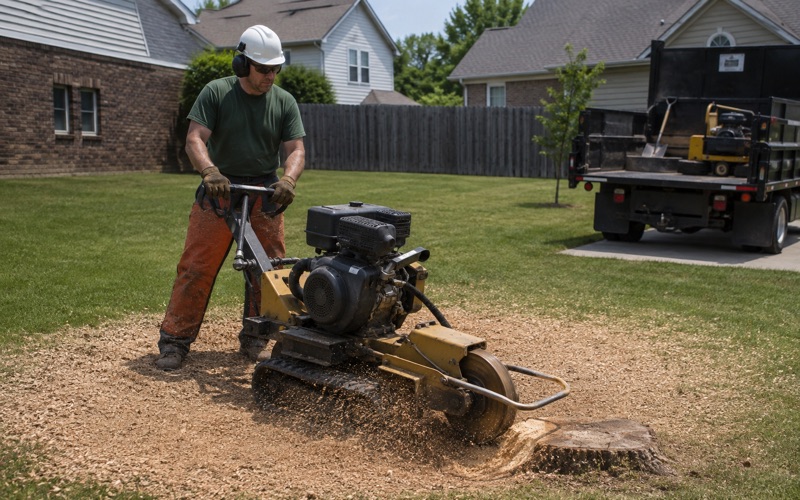
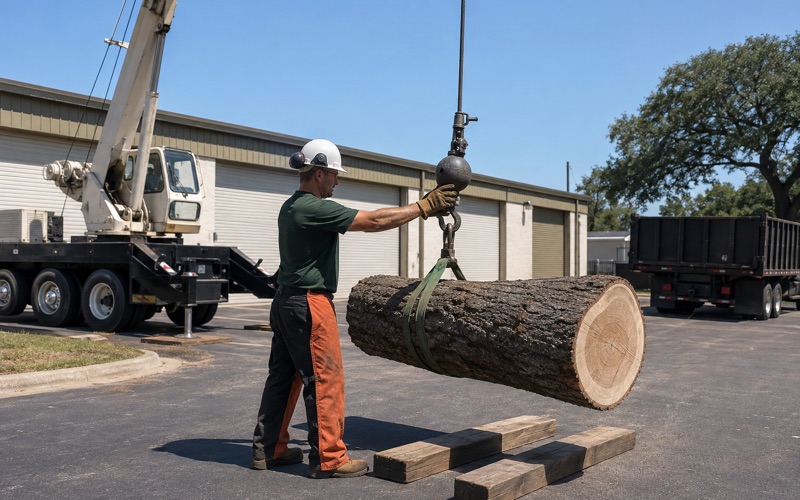
Crane capacity is rarely the binding constraint on a residential removal here. What decides the job is access, which is why we run compact tracked equipment sized to fit a back-yard gate. A subdivision tree behind a privacy fence does not have to become a crane job, and quoting it as one is how a straightforward removal gets expensive.
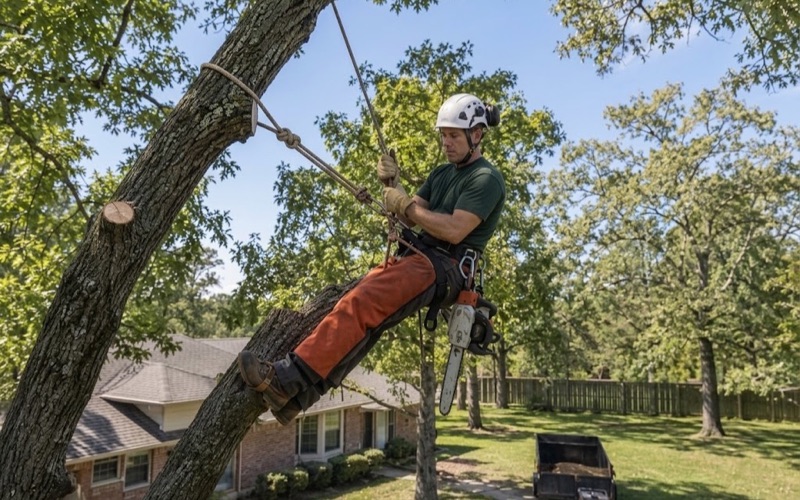
Rigging carries the rest of it. A limb that cannot simply be dropped comes down on a bull rope through a rigging block, with a friction lowering device at the base and a working load limit we know before the cut is made, which is what keeps a piece off a fence or a sunroom roof. The stump follows on a tracked stump grinder that came in through the same gate.
Looking for tree-removal closer to Oak Hill? See Oak Hill Tree-Removal.
The chipper service, and the line the city draws
What the city will collect
The City of Mount Juliet Department of Public Works runs zoned brush and chipper collection for single-family residential properties with frontage on a public street, across eight zones, at 615-773-7957. The standards are specific: no limbs larger than 10 inches in diameter, branches and limbs less than 15 feet in length, and material placed within 10 feet of the public roadway, never in a median or on or blocking a sidewalk. Routes take roughly six weeks during the April-to-October growing season and under one week from November through March, and service is suspended during rain, snow or a significant storm.
Vines, loose leaves, root balls, whole trees, lot clearing debris and anything intertwined with plastic, metal or wire are excluded outright. Those limits are worth knowing even if you are working alone with a pole saw, because they set the point where a Saturday cleanup stops being a do-it-yourself job.
Why a crew’s debris is not the city’s to collect
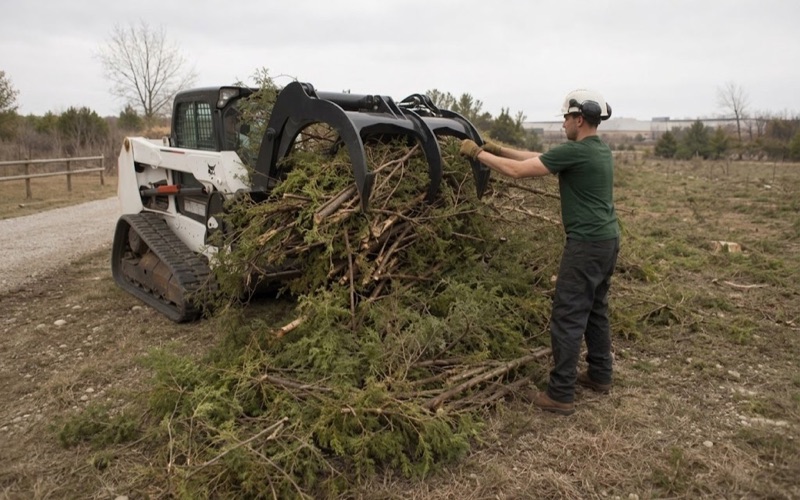
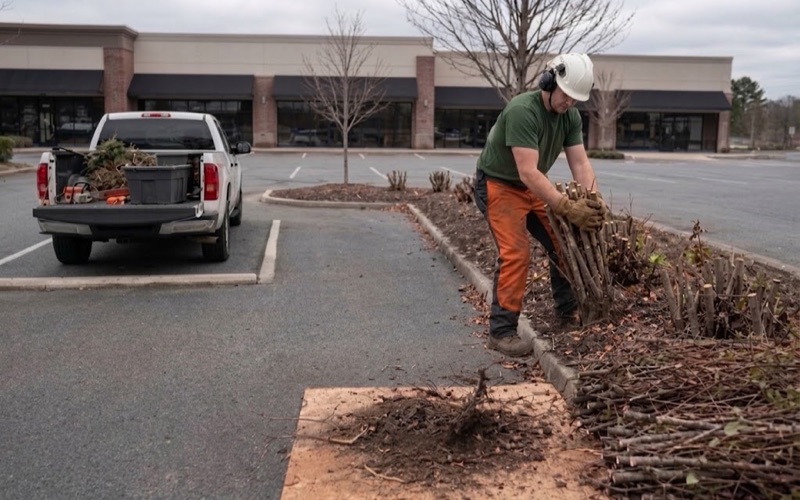
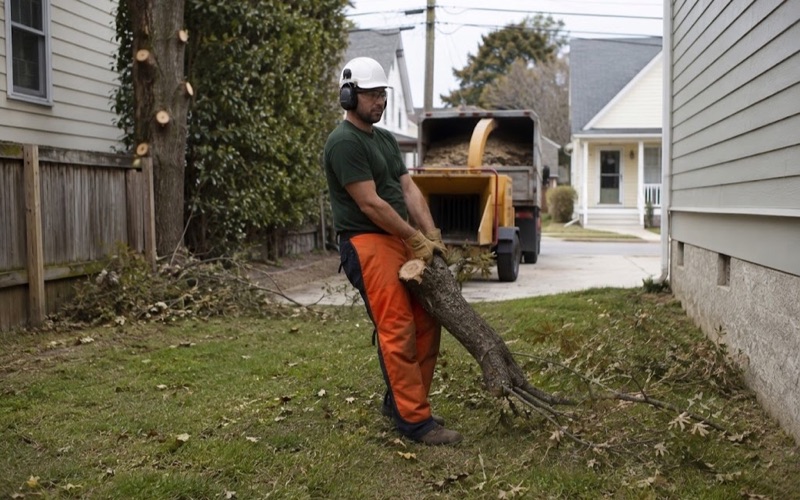
The rule is stated plainly: debris that is the byproduct of commercial cutting or trimming will not be accepted. A hired removal produces exactly that, and it produces it in the forms the service already refuses — whole trees, root balls, rounds well past 10 inches through. So everything that goes through our wood chipper leaves on our truck, and the trunk rounds leave with it.
We say so at the estimate rather than afterward. Disposal is priced for the county the job sits in, because the gates across our service area charge by the ton in one county and by the cubic yard in the next, and a Mount Juliet quote that treats haul-off as an optional add-on is a quote that is going to change.
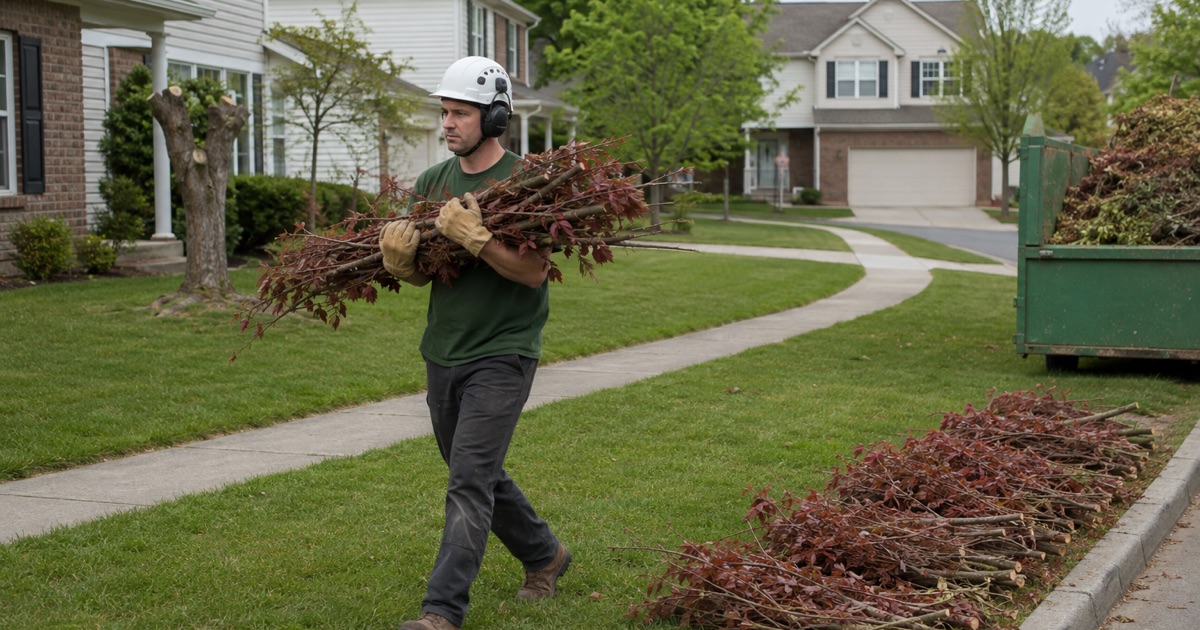
What leaves and what stays is your call, and we write it down either way. Some homeowners keep the trunk rounds cut to stove length and stacked at the side of the house, and some want the grindings left to backfill the hole rather than hauled off with everything else. Both are fine; what causes trouble is a crew that never asked and a pile at the curb the city has already said it will not touch.
Lines overhead, storms, and what the ground gives back
Middle Tennessee Electric owns the right-of-way
We check which utility serves an address before quoting any work near a conductor rather than assuming, and in Mount Juliet that is Middle Tennessee Electric. MTE maintains a 20-foot right-of-way clearance and a five-foot radius around service lines on its regular pruning cycle, and members may prune only outside the right-of-way, and only where the debris will not contact electrical equipment. Its contractors clear to the ANSI Z133 safety requirements.
Two of MTE’s published positions catch customers off guard. It does not top trees — also called rounding over or shaping — and it does not place dirt, seed, straw or similar material on a site after grinding a stump. We do not top either: the ANSI A300 pruning standard defines an objective and a cut type for every legitimate reduction, and none of them is a flat cut through a leader.
Storm work planned around what this county records
Middle Tennessee averages 18 tornadoes a year across 1995-2025, against 8 in West Tennessee and 6 in East. This city has its own dated entry in that record: the EF-3 of March 3, 2020, with maximum winds of 165 mph on a 60.13-mile path reaching nearly two-thirds of a mile wide, substantially damaged Mount Juliet Christian Academy, West Wilson Middle School and Stoner Creek Elementary and left extensive tree damage behind it overnight.
Ice is a different mechanism. The January 25-26, 2026 storm laid down half an inch or more of accretion, and ice loads limbs by weight, so it drops crowns onto roofs rather than pulling root plates out of the ground. Warnings here are issued for public forecast zone TNZ028, a single-county zone named Wilson, so an alert covers this county and not its neighbors — which is why our storm response is planned around the wind, tornado and ice loading this area actually logs.
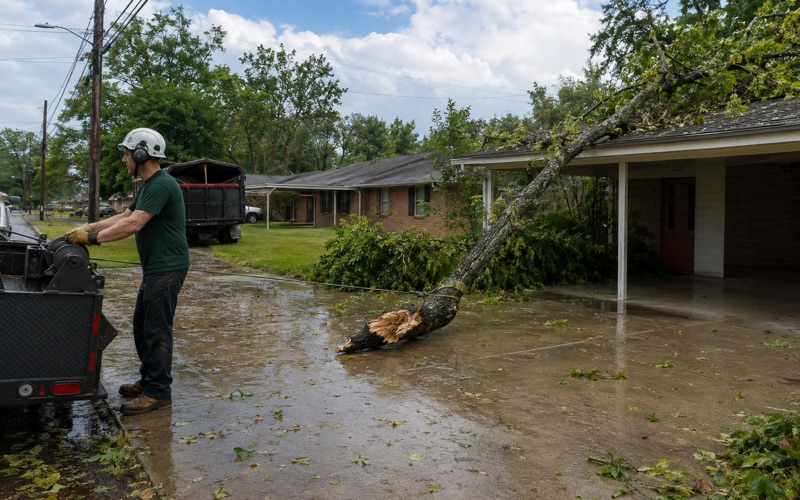
After a wind event the urgent work is rarely the tree that is already down. It is the hanger resting in a crotch forty feet up, the union that opened an inch and closed again, and the tree leaning into a neighbor’s roofline with fresh soil cracked on the far side of its root plate. A tree risk assessment sorts those into what has to come down tonight and what can wait for a scheduled crew, which is also what an insurer wants to see written out.
Keeping a young tree from becoming a removal
Structural pruning while the cuts are still small
The advantage of a young canopy is that its defects are still correctable. Crown cleaning and deadwooding on a twenty-foot yard tree cost a fraction of a removal, and a co-dominant union caught early can be held with a dynamic cabling system or with extra high strength cable and a brace rod instead of being lost in the next line of storms. Crown raising over a driveway is a pruning objective, not an excuse to strip a crown.
We will tell you when that is the honest answer. We will also tell you when it is not — a split union that has already moved, or a root plate lifting on one side, is a removal, and pruning it is money spent on a tree that is leaving anyway.
Spotted lanternfly, and what it actually means
Spotted lanternfly was confirmed in Wilson County in 2023. The Tennessee Department of Agriculture is clear that it may not directly kill trees, but that it can stress a tree and make it more susceptible to other issues; the visible nuisance is honeydew coating everything beneath an infested plant and the sooty mold that grows on it, along with egg masses that look like spattered mud. The real tree-service response is host-plant control, which means removing tree of heaven where it has volunteered along a fence line or a drainage easement.
Ordinance, records and credentials
Mount Juliet’s zoning ordinance protects trees on developing ground: Section 10-112.6 preserves existing trees of at least 1¾ inches caliper with a protected ground area equal to the greater of a seven-foot radius or one foot in diameter for each inch of the tree’s circumference, marked in the field during construction, and Section 10-113 requires unhealthy or dead plant material to be replaced within one year of notification or by the next planting period. We read the ordinance for the city a tree actually stands in, because this service area crosses six counties and the answer changes at the line.
Tennessee issues no trade-specific tree-care or arborist credential, and the state’s Home Improvement license band of $3,000 to $24,999 applies only in nine named counties, none of which is Wilson. What we can hand you is a written tree condition report you can give a neighbor, an insurer or an HOA architectural review committee — and a straight answer on whether a job is worth an insurance claim at all.
- 20+ Years in Middle Tennessee
- Free Written Estimates
- ANSI A300 Pruning, No Topping