Smyrna Tree Removal has been doing tree removal in La Vergne for more than twenty years, and the first thing we settle on a property here is usually not how big the tree is. It is how tall the ordinance will let it get.
La Vergne is one of the few addresses in our service area where a standing tree can be a regulated obstruction. Two airport height overlays reach across the city, and on the parcels they touch, the ceiling above a tree is set by a mapped surface rather than by a roofline, a fence, or a property boundary.
That reorders the work. Before we price a removal, a crown reduction, or a replacement planting, we establish which overlay the tree stands under and what the limit for that zone actually is, because the answer decides whether the job is routine, whether it needs a sign-off from the city, or whether it needs a federal determination before anyone can act on it.
A tree counts as an object of natural growth
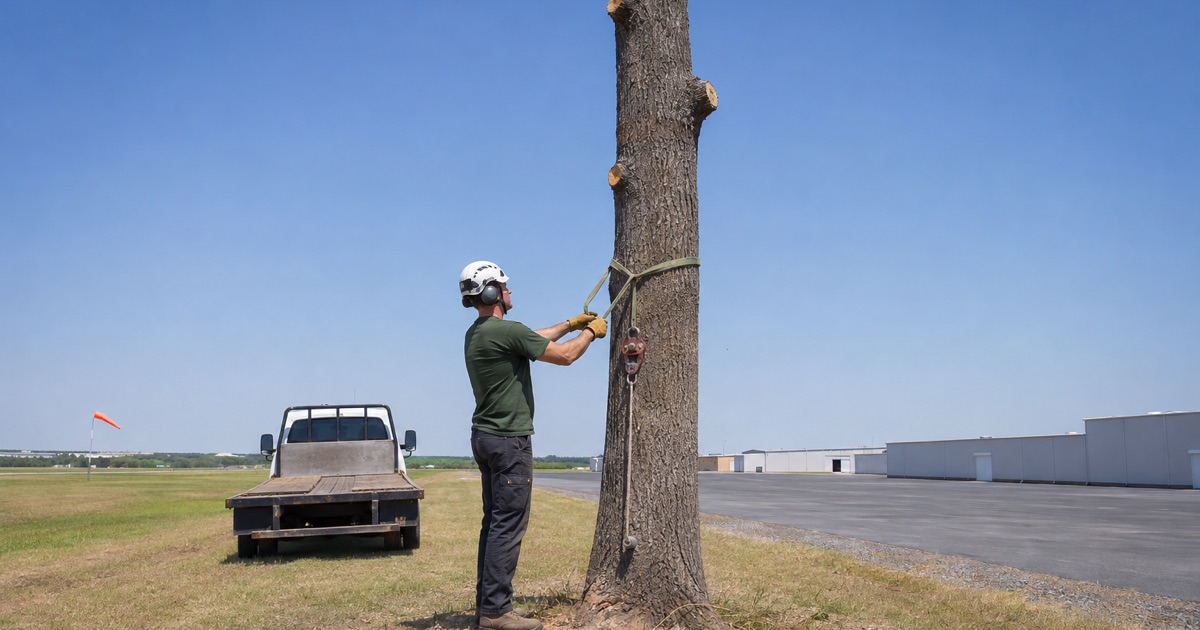
The height provisions in the La Vergne Zoning Ordinance do not describe trees the way a landscaping chapter does. They define a tree as an object of natural growth and put it in the same category as a structure, a pole, or a stack, then forbid an owner from allowing one to grow past the limit set for the zone it occupies.
That single definition is what makes the difference here. A tree is not exempt because it grew on its own, and it does not stop being an obstruction because nobody planted it. The obligation attaches to the owner who permits the growth.
Height is measured against a surface, not a fence line
An airport height zone is a sloped or level surface projected over the ground, so the allowed height on a parcel depends on where that parcel sits beneath the surface rather than on what the neighbors have. Two properties on the same street can carry meaningfully different ceilings, and a tree that has stood comfortably for decades can cross the limit in the year it finally puts on the last few feet of crown.
Because the limit is a plane rather than a number posted at the curb, the honest answer to “how tall can this oak get” is that it has to be worked out for the specific parcel. We would rather do that before we quote than after a crew is in the tree.
Two overlays over one city
La Vergne’s zoning ordinance carries height zoning overlays for two separate airports at once, Smyrna Airport under section 12.5 and Nashville International Airport under section 12.6, along with a floodway overlay for the parcels near Percy Priest Lake. The approach surfaces of two airports crossing one city of about 24.95 square miles is unusual, and it means a property can fall under one overlay, the other, or both.
Where they overlap, the governing limit is the more restrictive of the two. It is also worth being clear about what these caps do not depend on: they operate independently of any landscape requirement, so a tree can satisfy every planting rule in the ordinance and still be too tall at maturity for the aviation obstruction zone it stands in.
Looking for tree-removal closer to Nolensville? See Tree-Removal Services in Nolensville.
The permit question runs backward here
Most homeowners arrive expecting the rule they have heard about somewhere else, which is that a city makes you ask before you cut. That is not how this ordinance is built, and the distinction matters enough to state plainly.
No removal permit on a private lot
We read Chapter 9, Landscaping, end to end. It imposes no permit requirement and no diameter threshold for taking down an existing tree on private property, and its compliance review is triggered only at submittal of development plans, site plans, and preliminary plats, with the planting standards of section 9.3 applying to non-residential development.
This is not a gap in a document that ignores trees. The same chapter requires one canopy tree of 2.5 inch caliper or two understory trees of 1.5 inch caliper per 25 feet of road frontage, three canopy trees per 100 linear feet of parking perimeter, and carries a two-page tree specification list. It regulates trees in detail and still does not gate removal on a homeowner’s lot.
The permit is for keeping a tree, not for taking one down
Inside an airport height zone the direction reverses. The regulated act is planting a tree, or allowing an existing one to keep growing, where it will breach the limit for that zone, so the permission question attaches to the tree that stays rather than the tree that goes.
For an owner, that is a genuinely different conversation. A removal is generally the unregulated option and the retention is the one carrying conditions, which is the opposite of what people expect and the reason we ask about the overlay early.
When a variance needs a federal determination first
A variance from a height limit in these zones routes through a Federal Aviation Administration determination. That is a separate review at a separate level of government, and it is not something a tree crew can shorten by showing up sooner.
So we treat a variance as a schedule item rather than a formality. On most residential jobs, reducing a crown to a compliant height, or removing and replacing with a small maturing species, gets an owner to a settled answer faster than asking for extra feet.
Establishing the zone before we quote
This service area crosses six counties, and the answer to what a tree is allowed to be changes at the line. We read the ordinance for the city the tree actually stands in, and La Vergne is one of two cities on our map where that reading includes an aviation obstruction zone.
Measuring the tree instead of estimating it
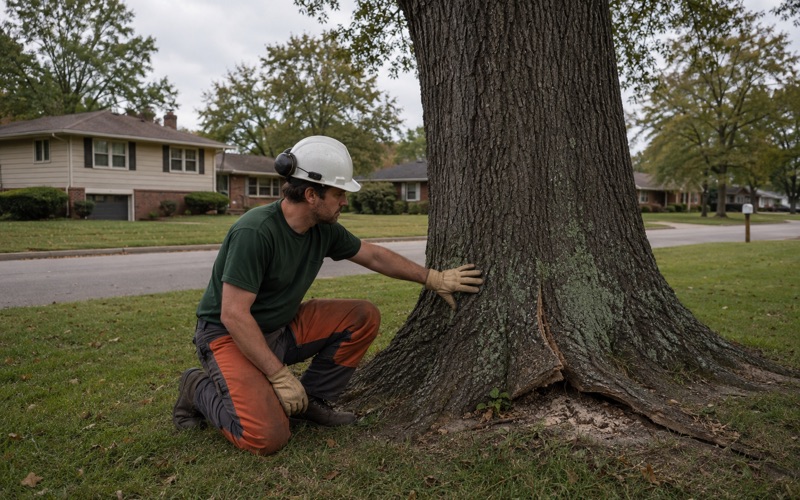
A quote here starts with numbers: diameter at breast height, total height, crown spread, and the condition of the root flare. Those figures decide the rigging plan anyway, and on an overlay parcel they also decide whether the tree is near a limit or comfortably under it.
We pair that with a tree risk assessment when the tree is close to a target, and we will say when a tree can be cabled, braced, or pruned rather than removed. When an owner needs the finding on paper for an insurer, a neighbor, or an HOA architectural review committee, we put the condition report in writing.
What the January storm demonstrated
The National Weather Service Nashville office recorded 2.1 inches of snow and 0.3 inches of freezing rain in Rutherford County over the January 24 to 28, 2026 storm, with temperatures as low as minus 4 degrees, measured at the Smyrna-Rutherford County Airport. Those are event observations rather than long-run normals, but they describe the loading a canopy here has to carry.
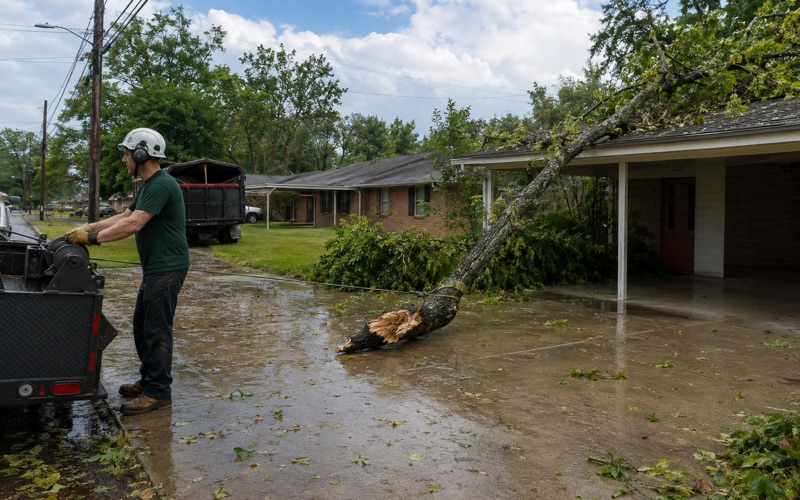
Ice loading is a documented structural agent in this part of Middle Tennessee rather than a regional generality, and a tree already close to an overlay ceiling is usually a tall, exposed one. We plan storm response around the straight-line wind, tornadoes, and ice loading this area actually records.
The line is a second ceiling
Middle Tennessee Electric holds a cleared electric right-of-way 40 feet wide, 20 feet on each side of the line, and its crews cut back or eventually remove what grows into it. We check which electric utility serves an address before quoting anything near a conductor rather than assuming, because that answer also changes across our service area.
The zoning ordinance anticipates the same conflict on the planting side. Where large maturing trees would otherwise be required and overhead lines exist, small maturing trees at one per 30 linear feet are substituted with the Planning Director’s approval under section 9.4.1(G), which is often the cleanest replacement answer on a parcel that is squeezed from above by a line and by an overlay at the same time.
Working around a tree that is already spoken for
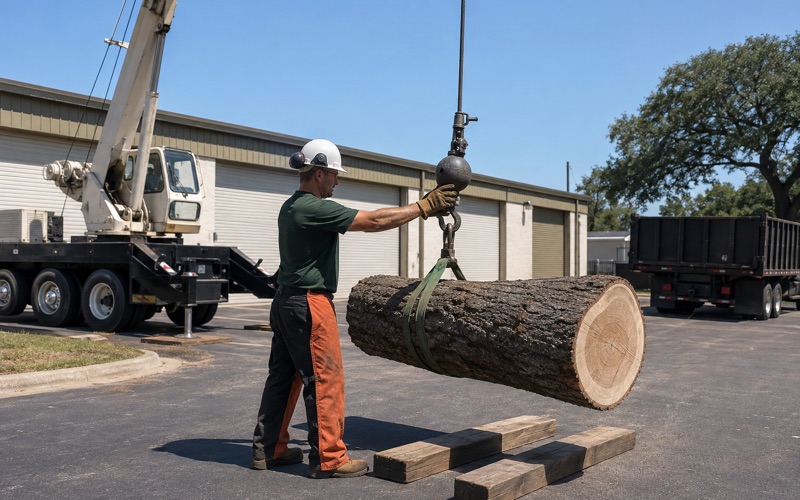
La Vergne has a large distribution and manufacturing base, with Ingram Content Group based in the city, and commercial removals here are shaped by site geometry more than by lawn. Perimeter planting strips of at least six feet average width and landscape islands at least eight feet wide every ten parking spaces set where a crane can outrigger and where a chipper can sit.
Tree protection zones and what they cost to ignore
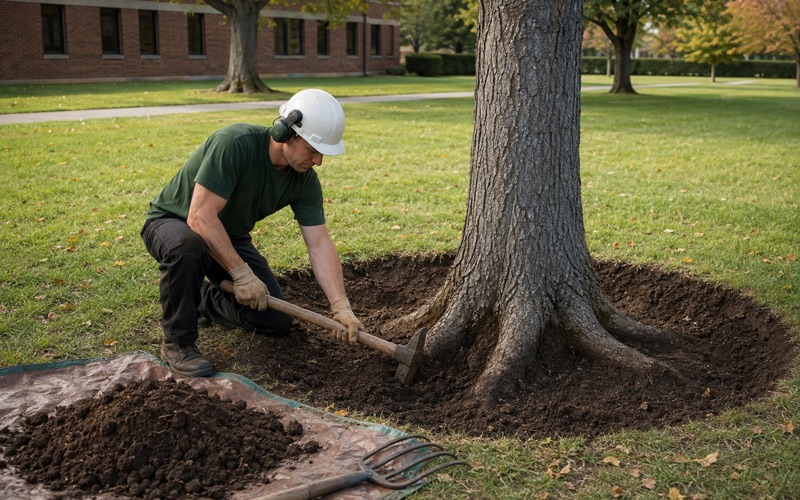
On any parcel where trees are being kept through construction, the tree protection zone is the working boundary: fencing at the drip line, no equipment traffic or material storage inside it, and no cutting into the root plate with a grinder or a trench. Compaction and severed roots do not show up the week they happen, which is why the fence goes up before the first machine arrives rather than after a problem appears.
That matters for existing vegetation being counted toward a required landscape screen, since the Planning Director and Municipal Planning Commission hold approval authority over whether it counts at all. A tree damaged during the work stops being an asset on the plan and becomes a replacement obligation.
Removal without a permit still carries obligations
Plant material shown on an approved landscape plan has to be replaced if it dies, is seriously damaged, or is removed, so taking out a tree that was counted toward that plan creates a replanting duty even though no removal permit exists. New required plantings carry a 24-month warranty from the installing contractor and a maintenance bond submitted to the Planning Director, which sets the local expectation for who carries risk on a replacement.
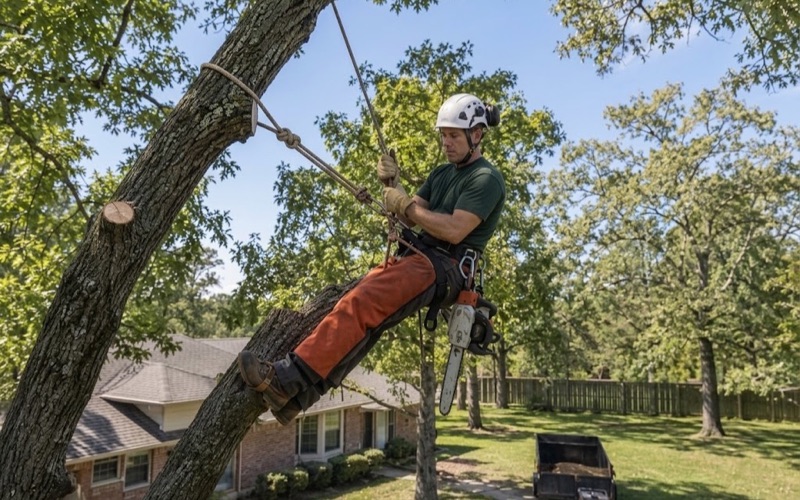
There is a matching rule on pruning. Required screening and buffer trees must be kept in their characteristic natural shape and must not be severely pruned, sheared, or topped, and a tree treated that way is deemed damaged vegetation to be replaced within a year. We work to the objectives and cut types the ANSI A300 standard defines and we do not top trees, on a required tree or any other.
What leaves the property, and on whose ticket
The city’s approved canopy tree list still includes two Callery pear cultivars, Aristocrat and Cleveland Select, so we are asked about them regularly. Their small mature size keeps them under a height limit easily, and the tradeoff we point out is the co-dominant stems and included bark the species is known for.
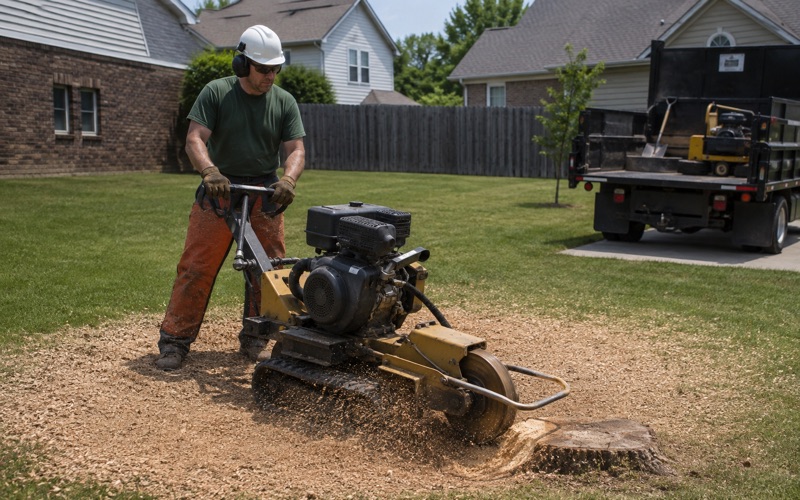
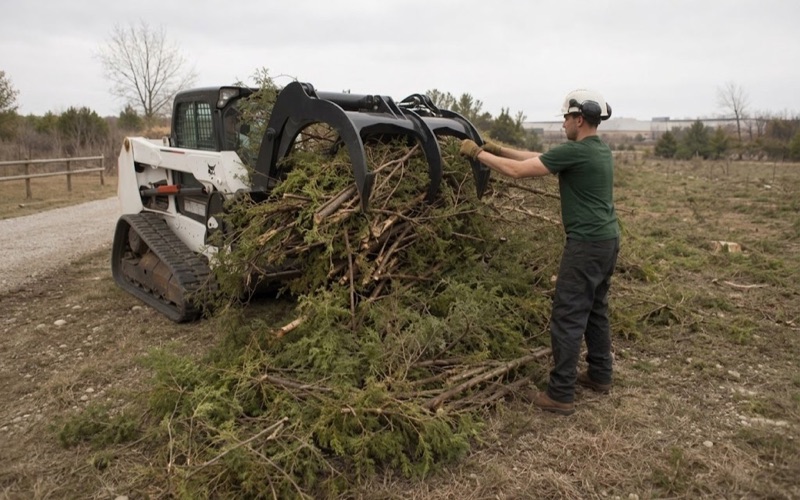
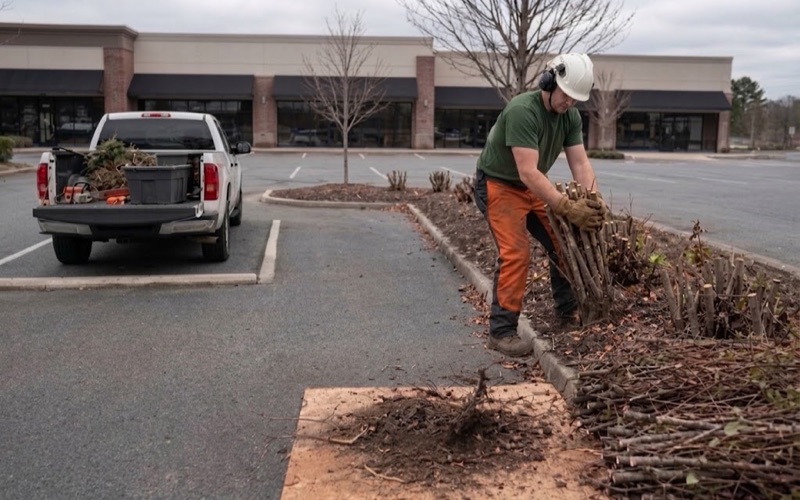
We put the inclusions in writing before we start, meaning the trunk rounds, the stump, the grindings, and the chips. The town does not collect contractor-cut brush, so we haul it, and we price disposal for the county the job is in, because the gates here charge by the ton in one county and by the cubic yard in the next. Estimates are free, and if a job is not worth an insurance claim we will tell you that too.
- 20+ Years in Middle Tennessee
- Free Written Estimates
- ANSI A300 Pruning, No Topping