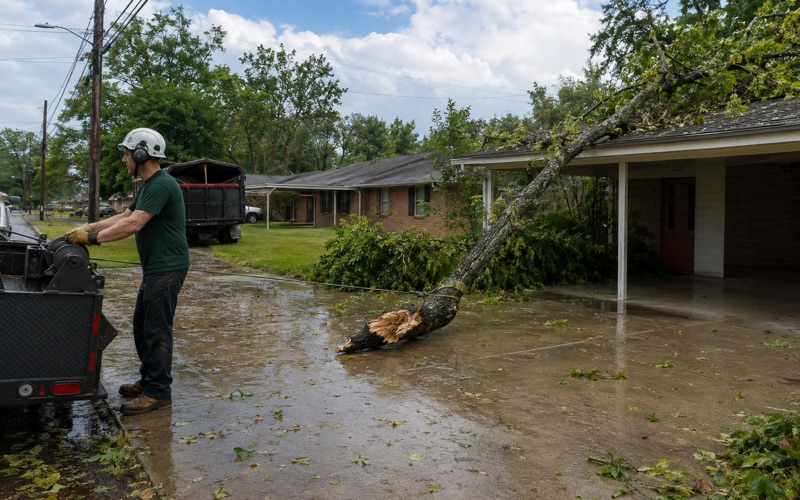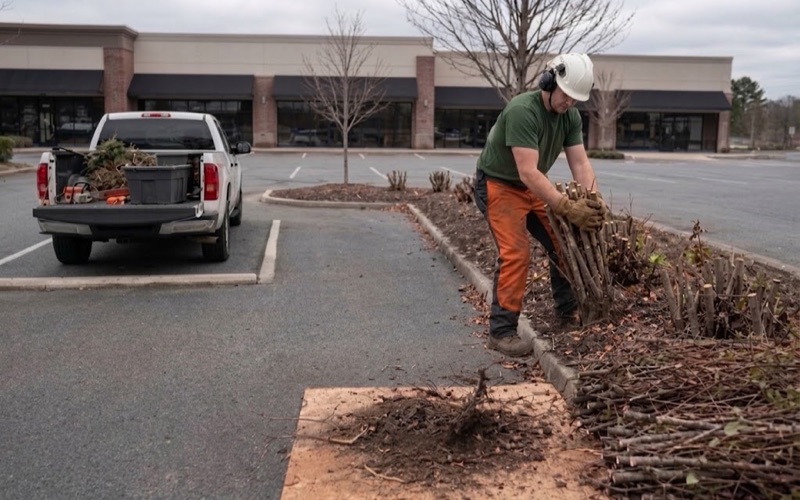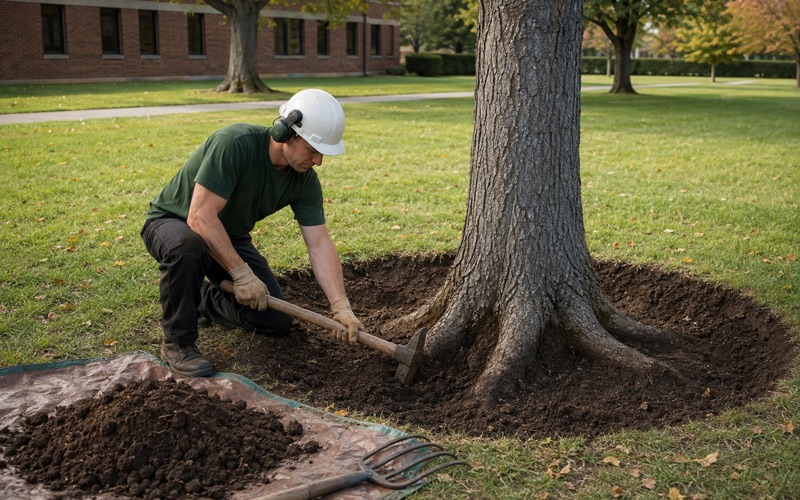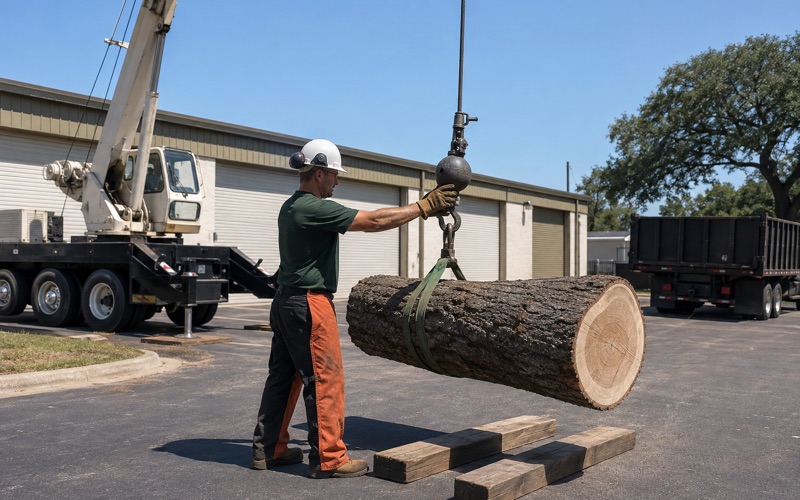
Smyrna Tree Removal has handled tree removal in Goodlettsville for more than twenty years, and most of what makes a job here different from one a few miles away has nothing to do with the tree. It has to do with which county your driveway sits in. We settle that question before we price the work, not afterward.
That is not a technicality. The city limits cross a county line, and the trade permits, the licensing answer and even the forecast that governs a storm call all change depending on which side of that line an address falls on. Our service area crosses six counties, so we read the rules for the city and the county the tree actually stands in rather than assuming the last job’s answer carries over.
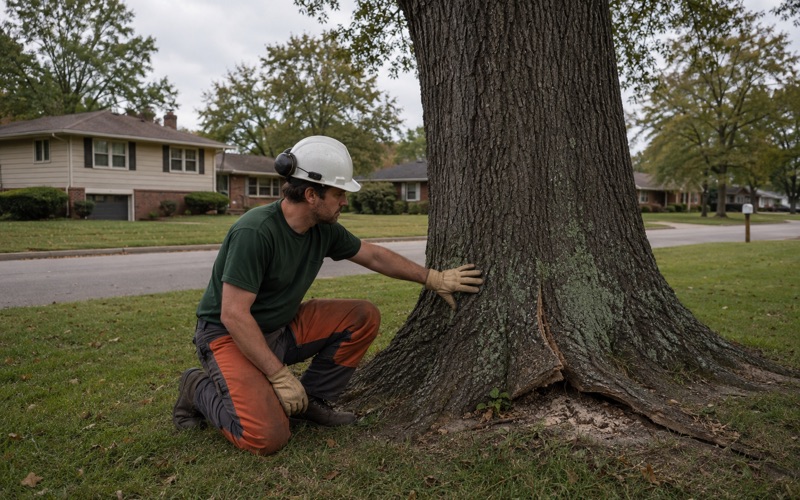
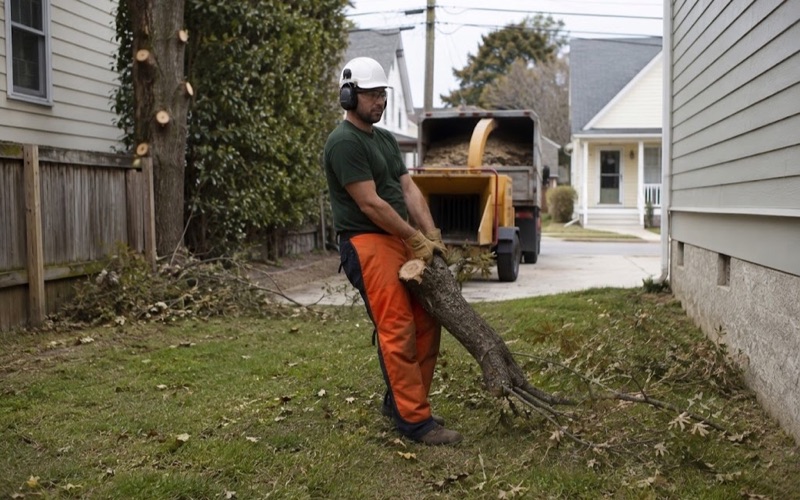
What you get from us is an estimate that names the work: what comes down, what gets hauled, and what stays behind. The trunk rounds, the stump, the grindings and the chips are all written into the scope before a saw starts. Estimates are free, and when the honest answer is that a tree can be pruned, cabled or braced instead of removed, we say so.
One set of city limits, two county answers
Goodlettsville sits about 15 miles north of downtown Nashville, and its city limits straddle the Davidson and Sumner county line. The northern half of the city is in Sumner County and the southern half in Davidson; more than 50 percent of the land area is on the Sumner side, while roughly 60 percent of residents live in the Davidson portion. For a homeowner, that split is invisible right up until it isn’t.
The city kept its own charter when Nashville and Davidson County consolidated in 1963, one of six incorporated communities allowed to do so, and it retained its own police force and its own zoning regulations. Land use inside the city limits is governed by the city’s own zoning ordinance on both sides of the county line. Anyone who has read Metro’s rules and assumed they reach into this city has read the wrong document.
Which desk signs off on which side
The City of Goodlettsville Building and Codes Department on North Main Street issues the building permit for construction anywhere inside the city limits, on both the Davidson and the Sumner side, and performs the building and fire inspections itself. The downstream trade permits are where the split shows up. In the Davidson County portion, the plumbing, gas and mechanical, and electrical permits, along with both the rough-in and the final inspections on them, come from the Metro Nashville Codes Department, and the city withholds occupancy until every one of those finals is complete.
On the Sumner County side the arrangement inverts. The city performs the plumbing, gas and mechanical, and fire and life safety inspections itself, and only the electrical permit and its final inspection go to the State Electrical Inspector’s Hendersonville office, with no certificate of occupancy until that inspection is done.
What that means for a tree job
Straight removal on a developed residential lot rarely touches that stack of permits. We found no city requirement that attaches a permit to taking a tree off an existing developed single-family lot; the city’s tree-related obligations appear to attach to development and site plan approval instead, through the landscaping, screening and buffering plantings imposed when a site plan is reviewed.
Clearing tied to a build is a different animal. When a removal is part of a project going through permit review, knowing which authority the next signature comes from is the difference between a scheduled crew and a wasted morning.
Looking for tree-removal closer to Shackle Island? See Tree-Removal Services in Shackle Island.
The licensing answer that changes mid-city
Tennessee licenses no tree-care or arborist trade. There is no state credential a tree crew can produce showing the state has examined them on felling, rigging or pruning, and the Tennessee Division of Forestry’s own guidance points homeowners toward ISA certification rather than any state card. A state contractor license is required at and above $25,000 in materials and labor, which most residential removals sit well under.
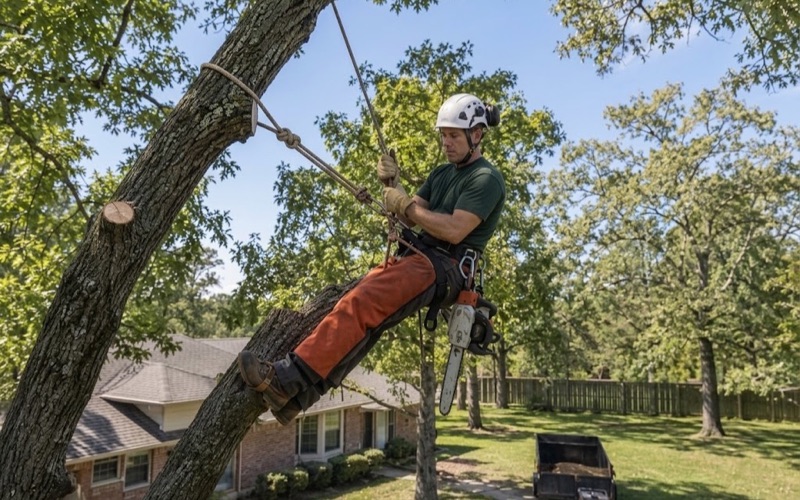
So the useful questions are the ones the state does not ask on your behalf. Whether the crew works to the ANSI A300 pruning standard and the ANSI Z133 safety requirements, whether a real tree risk assessment was done on the tree in question, and whether the scope is in writing before the truck arrives. We do not top trees, and we will tell you when crown cleaning, crown reduction or a cabling and bracing plan does the job a removal was quoted for.
The Tennessee Home Improvement license stops at the county line
The Tennessee Home Improvement license covers residential work in the $3,000 to $24,999 band, and it is county-option rather than statewide. It applies only in Bradley, Davidson, Hamilton, Haywood, Knox, Marion, Robertson, Rutherford and Shelby counties. Davidson County is on that list. Sumner County is not.
That is how one city ends up carrying two different answers inside one set of city limits, split along the same line that splits its trade permits. A neighbor two streets north may have been told something different about a job in the same price range, and both of them can be right. We establish which side of the line an address falls on before we quote, so nobody discovers it at invoice time.
Two forecast zones over one set of streets
Because National Weather Service public forecast zones in Tennessee follow whole county lines, this city falls inside two of them at once: TNZ027 Davidson and TNZ008 Sumner, both issued by the Nashville office, OHX. A point query at the city’s gazetteer internal point returns the Sumner zone, and one run at City Hall returns the Davidson zone.
In practice a warning can be live for one zone and not the other while both cover Goodlettsville streets. We watch both when we are staging storm crews, because standing down on a Davidson zone warning is no help to a customer whose address reports to Sumner.
The storms this area actually records
The National Weather Service Nashville office records an average of about 10 tornadoes a year across Middle Tennessee over the 1950 to 2025 record, and about 18 a year over the shorter 1995 to 2025 period; those are climatological counts rather than a forecast. The June 21, 2019 derecho was the most widespread damaging wind event to hit Middle Tennessee in at least 15 years, damaging poles and lines and causing more than 100,000 outages, some of them lasting a week.
The ice storm of January 24 and 25, 2026 was described as the worst in decades here, crippled the power grid, and left debris volumes far above normal for months afterward, with Nashville estimating roughly $80 million in damage. We plan storm response around straight-line wind, tornadoes and ice loading, because that is what actually fails trees in this part of the state.
Ice finds the weak unions first. The canopy over this city is Outer Nashville Basin oak-hickory grading toward mixed mesophytic forest, and on a post-storm walk the co-dominant stems with included bark in a white oak or a tuliptree are the first thing we look at.
Which utility owns the right of way
Two electric utilities serve this city depending on the address, Nashville Electric Service and Cumberland Electric Membership Corporation, and most homeowners cannot tell which set of right-of-way rules governs their own tree without checking their bill. We check before we quote anything near a line.
NES manages vegetation along each circuit on a planned three to four year cycle and removes all vegetation within a safety maintenance zone of at least a ten-foot radius around every pole, a no grow zone in practice. Its contractors chip or remove limbs during normal trimming, but NES does not clear debris caused by a storm or by tree or limb failure. That leftover is ours to handle.
CEMC maintains a 20-foot clearance on both sides of its lines, includes clean-up in its vegetation program, and is clear that the tree still belongs to the member. Before we prune or remove near the secondary service to a house on CEMC lines, we have a service order set up to drop the service line.
Brush, grindings and what the city will not haul
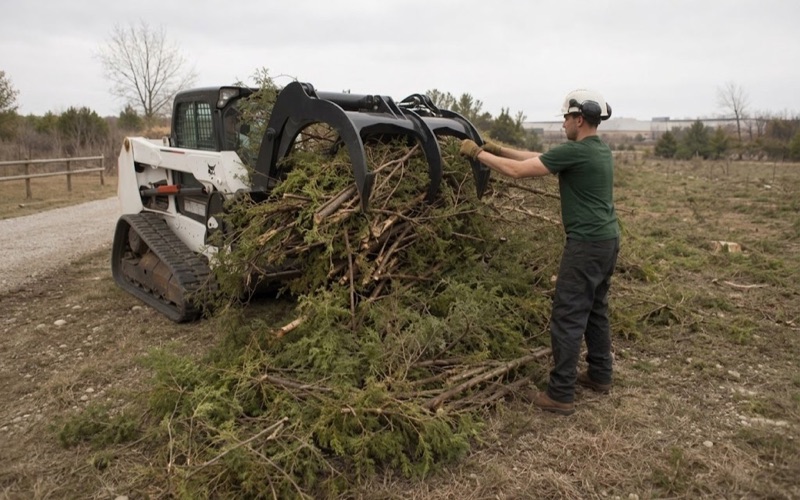
The City of Goodlettsville collects residential brush and limb set-outs on a rotating six-zone schedule, with roughly six weeks between passes in the same zone. The published rule states plainly that the city does not pick up yard waste generated or produced by contractors, tree trimmers, or persons doing work for profit or personal gain, and that removing and disposing of that material is the responsibility of the contractor, developer or property owner.
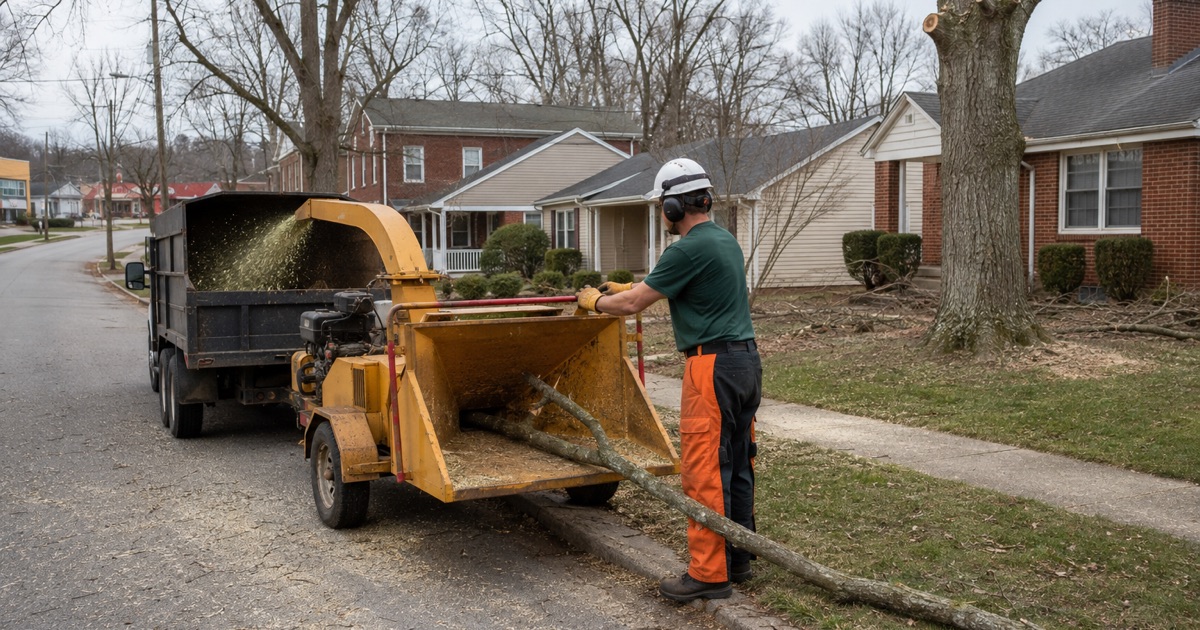
We say that out loud before the job rather than after it. A pile left at the curb by a tree crew is not getting collected, and a homeowner who assumed otherwise is the one left standing next to it. Haul-away is on us, and it is written into the estimate alongside everything else.
What a resident can still set out
For material a homeowner cuts themselves, the city’s limits are specific: limbs may not exceed eight inches in diameter or ten feet in length, and brush has to be stacked neatly and un-scattered with the cut ends facing the street, kept off water and gas meters and away from utility poles, and free of bagged yard waste, wire, plastic, concrete, metal and nails. Anything outside those limits is a job for a truck rather than the curb.
The Goodlettsville Convenience Drop-off and Recycling Center accepts tree limbs and brush from city residents on proof of residency and excludes commercial and industrial waste, so it is not a disposal route for a contractor’s load either. Our trucks go where a commercial load is actually accepted, and the cost of that is in the number we quote.
Stumps, and what the grinder is really fighting
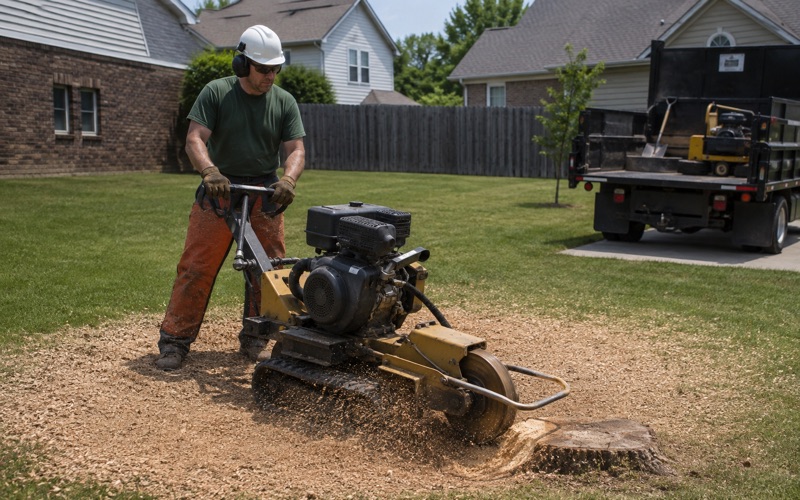
Depth to bedrock is not the constraint on stumps here. The Outer Nashville Basin soils under this city, Mimosa, Dellrose, Armour and Maury among them, run from 40 inches to well over five feet down to rock, so a tracked stump grinder cutting 12 to 16 inches below grade reaches its own mechanical stop long before it reaches limestone.
What wears a grinding wheel in Goodlettsville is chert volume instead. The Dellrose series, which occupies foot slopes and hillsides at slopes dominantly 12 to 40 percent, carries 10 to 35 percent chert fragments in every horizon above the discontinuity and as much as 50 percent in the lower Bt horizon. We price grinding with that in mind, and the estimate says whether the grindings stay in the hole or leave on the truck.
- 20+ Years in Middle Tennessee
- Free Written Estimates
- ANSI A300 Pruning, No Topping