Smyrna Tree Removal has taken trees down in Gallatin for more than twenty years, and on a Gallatin quote the first thing we establish is which wire the tree stands nearest. The city owns and runs its own electric utility, and that one fact decides who is allowed to touch the conductor, who pays to have it dropped, and what is still standing in the yard after a utility crew has come and gone.
The Gallatin Department of Electricity publishes a written tree trimming policy covering clearances, a trim cycle, a safety maintenance zone, a hazard test and planting guidance. It is unusually clear about where its own responsibility stops: it does not maintain service wires, it does not remove trees near them, and it does not grind stumps.
Everything past that boundary belongs to the property owner, which in practice means it belongs to whoever the property owner hires. We read the utility’s policy before we price the work, because this service area crosses six counties and four electric utilities and the answer changes at the line.
A municipal utility with its own rulebook
The Gallatin Department of Electricity operates under the Municipal Electric Plant Law of 1935. It takes 161kV transmission power from TVA generation into its own distribution substations and maintains every primary line at 12,470/7,200 volts along with the secondary system behind it. What it does not maintain, by its own written statement, is the service wire running to a house.
The clearances it publishes
GDE asks for a minimum of 15 feet of clearance from any power line for trees, and no limbs hanging over any power line regardless of the distance between the limb and the line. Small shrubs need a minimum of 10 feet of clearance from the base of a pole on all sides. Pad-mounted transformers and vaults want 10 feet on the front, the door side, and at least 3 feet on each side and around the back.
The right-of-way, which is wider than the clearance
The safety maintenance zone is a separate rule and a larger one. GDE asks that no trees or woody shrubs stand within a 15-foot radius around each pole, and that where a line runs along the side or rear of a property with no paved or gravel access, the ground extending 15 feet either side of the line be kept free of trees and woody shrubs. It also reserves the right to maintain any easement or right-of-way the property owner has not maintained, at its discretion and in whatever manner it judges appropriate, which is reason enough to handle right-of-way clearance on your own schedule instead of somebody else’s.
A three-year cycle, worked laterally
The utility’s stated target is to complete one trimming cycle within three years, run as a rotational program section by section. Its method is lateral trimming to ISA practice, with no topping and no rounding, and a V cut for trees growing directly under the conductors, while noting that removal is usually the better answer in that position. We work to the objectives and cut types the ANSI A300 pruning standard defines and we do not top trees either, so a crown we shape near a line is not undoing somebody’s earlier shortcut.
Looking for tree-removal closer to La Vergne? See Tree-Removal in La Vergne.
Getting the service line dropped before we climb
The service line is the span between the pole and the weather head on the house, and it is the wire most back-yard removals here are genuinely working around. GDE states that it does not remove trees near service lines, that the property owner is responsible for removing trees that may affect them, and that it will disconnect service free of charge, during regular business hours, so a customer can have a private tree removal company take the tree out.
That is the utility routing the job to a crew like ours and covering the one part only it can perform. We treat the disconnect as a scheduled step in the work rather than a call somebody makes on the morning of, because it has to land inside business hours and the house is without power while the drop is off.
What we ask you to plan around
A free disconnect is well worth having, and the price of it is a working stretch of the day without power at the meter. Anything in the house that needs electricity through that window is worth sorting out the day before, not once the chipper is already in the driveway.
Why the line comes down first
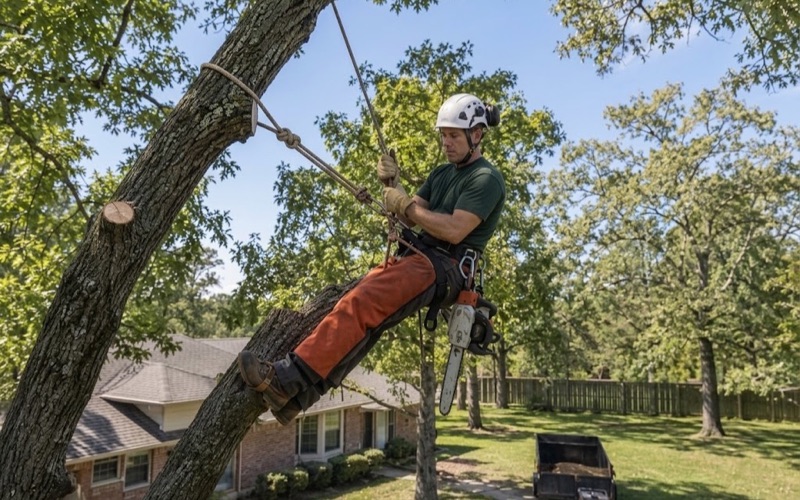
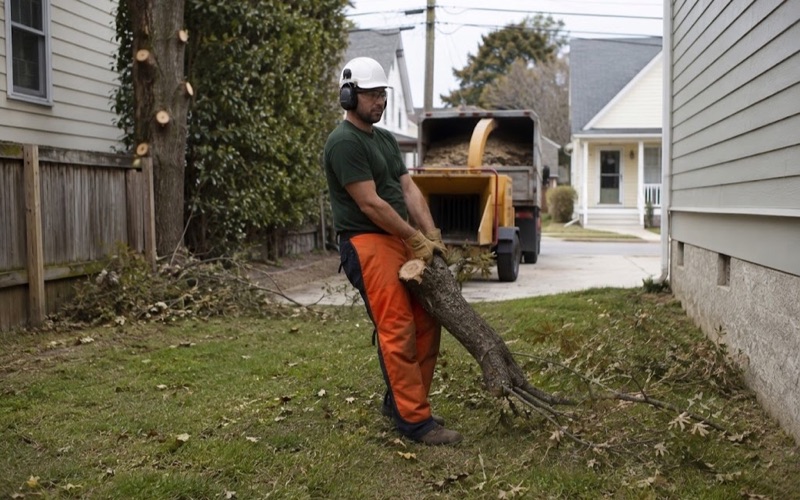
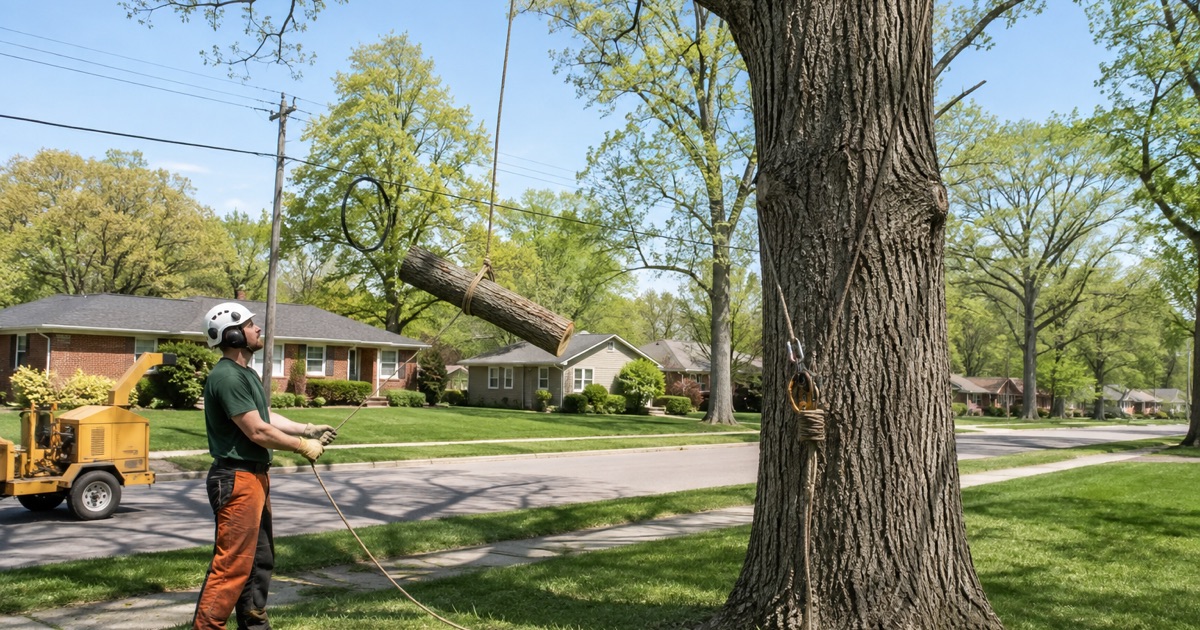
Line clearance work beside an energized drop is a different job from the same tree in an open field, and the rule about limbs overhanging a conductor holds no matter how much air sits between them. With the drop disconnected we can rig the side of the canopy that overhangs it properly, on a friction lowering device with the bull rope through a rigging block and every piece sized under the working load limit, instead of picking at the tree from the far side.
Communication lines are a separate matter: GDE does not own or maintain them, so a cable or telephone drop tangled in the same canopy is a call to that provider rather than to the electric utility. We flag it at the estimate, because a crew held up waiting on a second disconnect is a crew that is not cutting.
Limbs over the line, and the fifteen-foot test
The hazard rule GDE publishes turns on a single distance. A tree it deems a hazard whose trunk or limbs sit within 15 feet of primary power is a candidate for removal by the utility, if it cannot be trimmed to eliminate the threat. A hazard tree whose trunk and limbs are not within 15 feet of primary power is the property owner’s responsibility.
In that second case the utility may elect to take off limbs or portions of trunk that could strike its equipment, and it says plainly that removal of the remaining tree and disposal of all the wood debris falls to the owner. That is the call we field most often in this city: a tree relieved of the side facing the line and left standing with the rest of its weight leaning toward the house.
A half-cleared tree is not a settled one
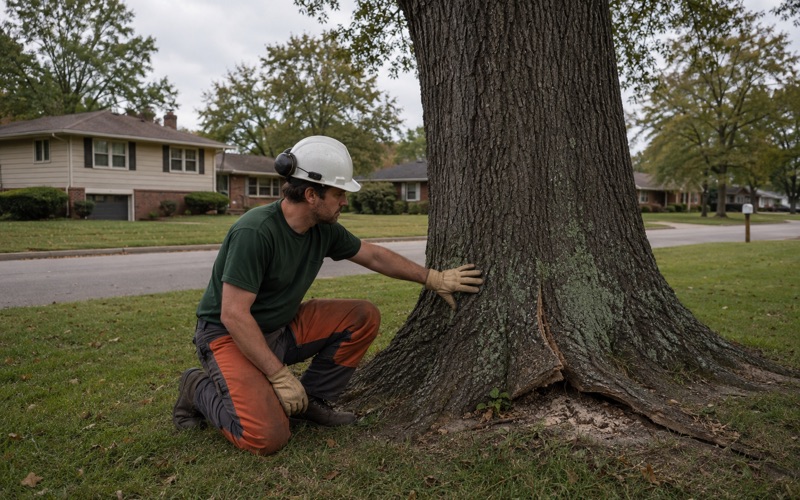
A stem stripped down one side is not the tree that stood there a week earlier, particularly where co-dominant stems and included bark were already carrying more than their share. We look at the root flare, at any conk at the base, and at how the remaining crown is now loaded before we recommend removal over crown cleaning or a cabling and bracing repair. Sometimes the honest answer is that the tree can stay, and we would rather say so than sell a removal.
Dead ash is the other version of this we meet near a line. Emerald ash borer has been established in Tennessee since 2003, it kills a large ash within about three years, and the wood goes brittle quickly afterward. A brittle stem over a service drop is a harder climb than a live one of the same size and a worse candidate for waiting, which is a reason to deal with it before a storm does.
What we establish before quoting
We check which of the four utilities in this service area actually serves the address rather than inferring it from the city name, and we establish whether the tree stands inside the airport overlay height limits this city applies to objects of natural growth. Where a decision has to be explained to somebody else, we write a tree condition report a homeowner can hand to a neighbor, an insurer or an HOA architectural review committee. Gallatin has been the seat of Sumner County since 1802, and the older lots near the downtown square carry mature canopy over service drops that arrived long after the trees did.
What the utility leaves behind, and what we haul
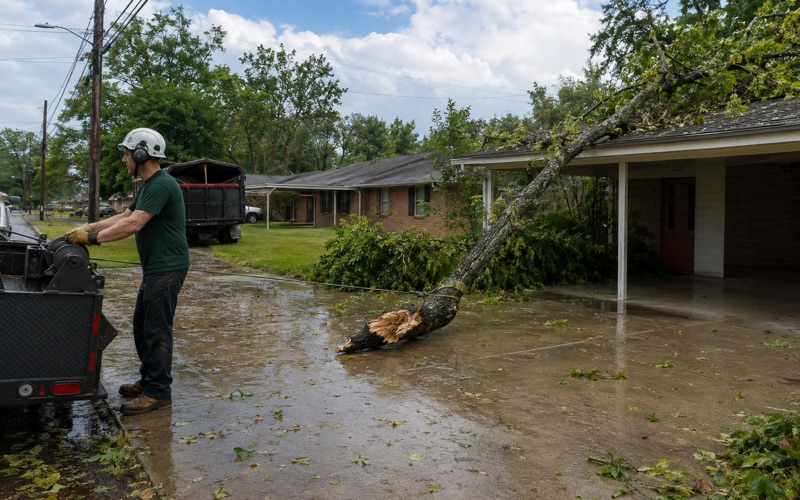
During routine trimming, GDE’s contractors remove and chip the limbs and debris that may fall onto the customer’s property. After storm work the cleanup of tree debris is the customer’s, and the utility grinds no stumps in either case. The load cases behind that storm work are documented rather than rhetorical: the National Weather Service office at Nashville records an average of 18 tornadoes a year across its area over 1995 to 2025, and the ice storm of January 24-25, 2026 laid down a quarter to a half inch of ice and more.
The brush route has a ceiling
City brush trucks run a continuous route on roughly a four-to-six-week cycle with no scheduling, and the interval depends partly on the wait at the county disposal gate. The free service covers limbs, branches, logs and shrubbery for city trash customers only, capped at one trailer load of up to 20 cubic yards per pickup cycle, with $75 for each additional trailer. Limbs and logs have to be no longer than 15 feet, stacked facing the same direction and set within 2 feet of the curb rather than on it, with no mixed debris.
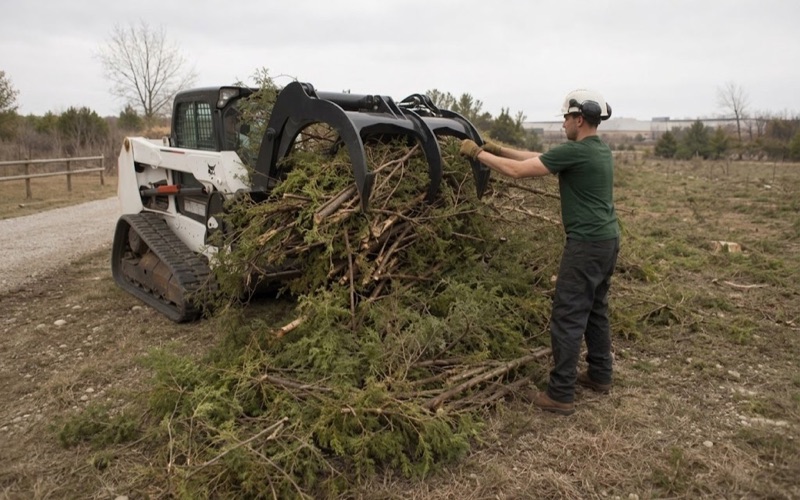
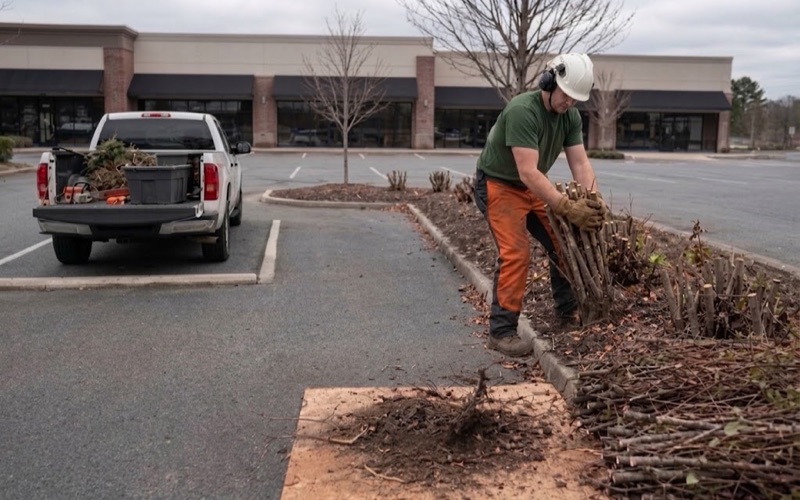
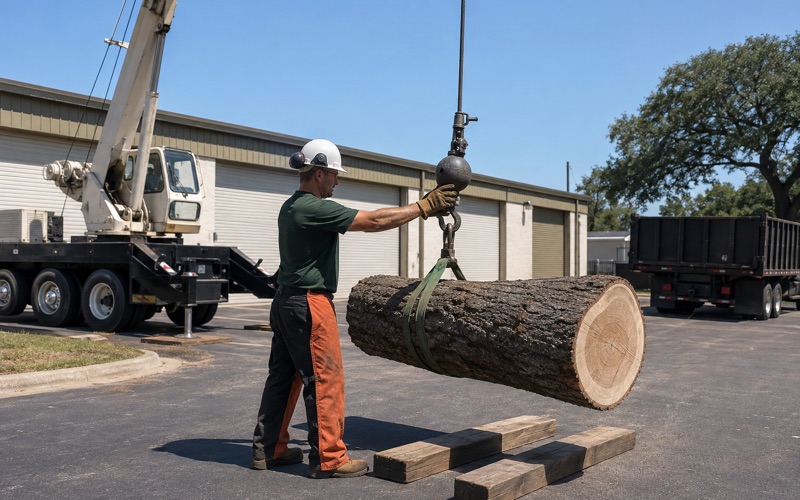
A whole-tree removal passes 20 cubic yards without trying, and a four-to-six-week wait is no answer when the wood is lying across a driveway. So we haul our own debris, and we put the inclusions in writing before we start: the trunk rounds, the stump, the grindings and the chips. The Resource Authority in Sumner County prices yard waste, brush and clean untreated wood by weight, at $45 per ton with a $10.00 minimum, so a load allowed to dry costs less at the gate than the same load green.
The stump, since the utility will not
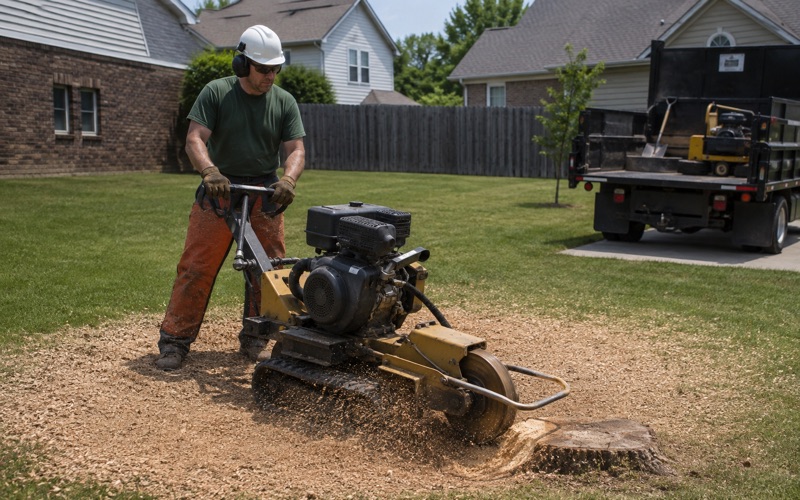
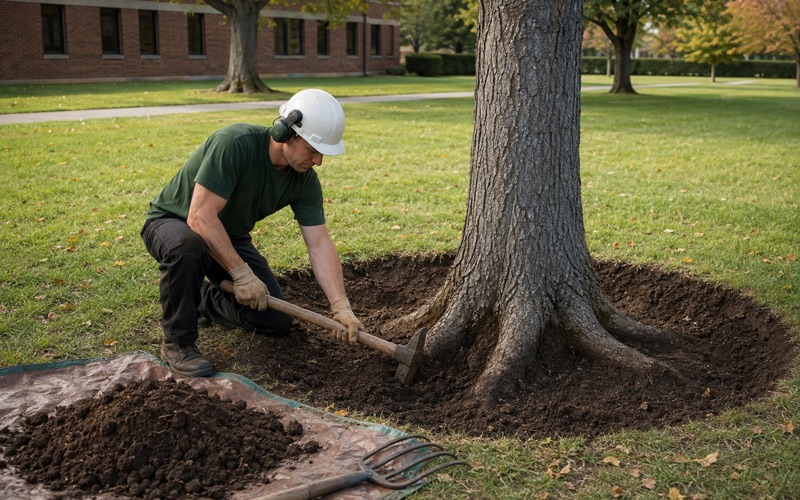
A tracked stump grinder in the narrow-access class, the machine that fits through a back-yard gate, cuts 12 to 16 inches below grade. On the ground here that is the number that binds rather than the rock: Talbott runs 20 to 40 inches to bedrock and Bradyville 40 to 60, so the grinder reaches the end of its own travel well before it reaches limestone. What we promise on grind depth is therefore a machine specification, and we say so rather than implying the soil decided it.
Planting back underneath a line
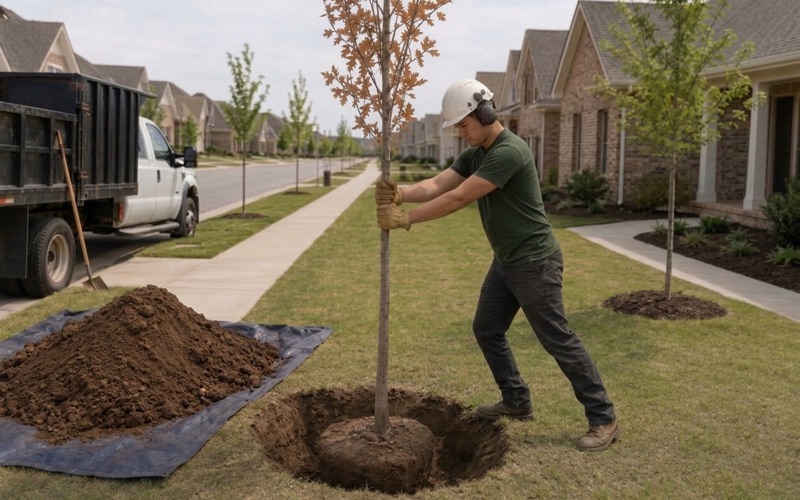
GDE’s planting guidance is the shape of the replacement conversation after a removal. It asks for no trees or woody shrubs within 15 feet of the outside phase, and for a tree that will reach a mature height of 30 feet to be planted 30 feet from the power lines. Its published species classes run Large above 50 feet, Medium at 30 to 50, Small at 20 to 30 and shrubs under 20, and the small class it names, redbud and crepe myrtle and flowering dogwood among them, is where a front yard under a conductor ought to be shopping.
- 20+ Years in Middle Tennessee
- Free Written Estimates
- ANSI A300 Pruning, No Topping