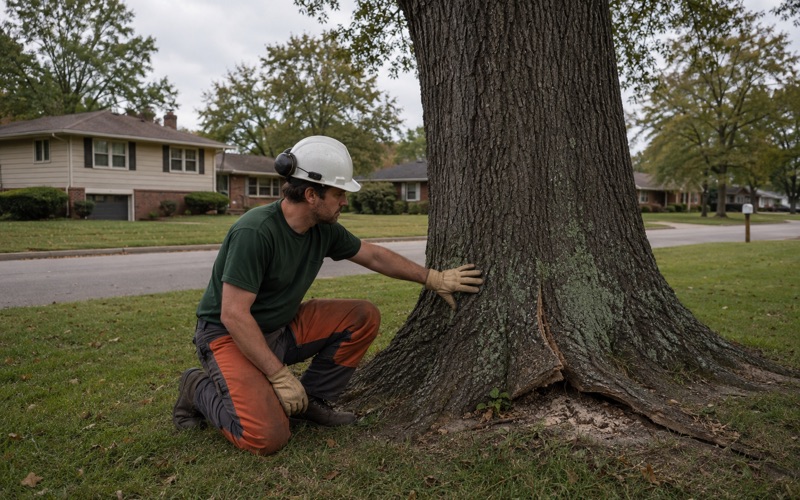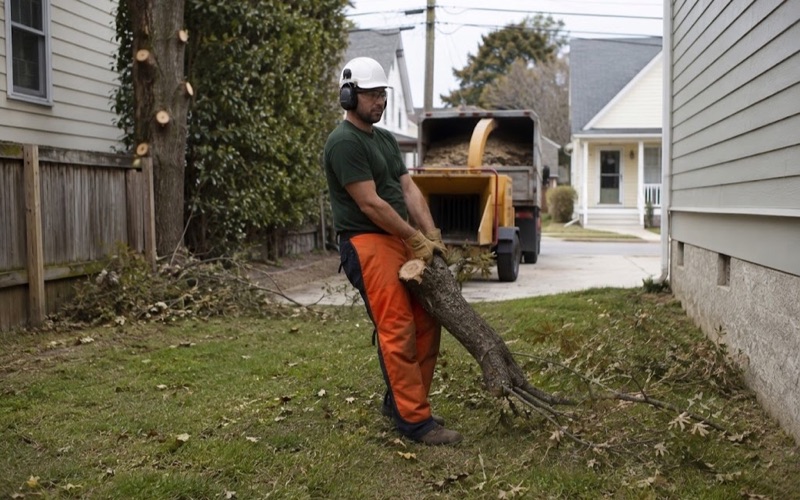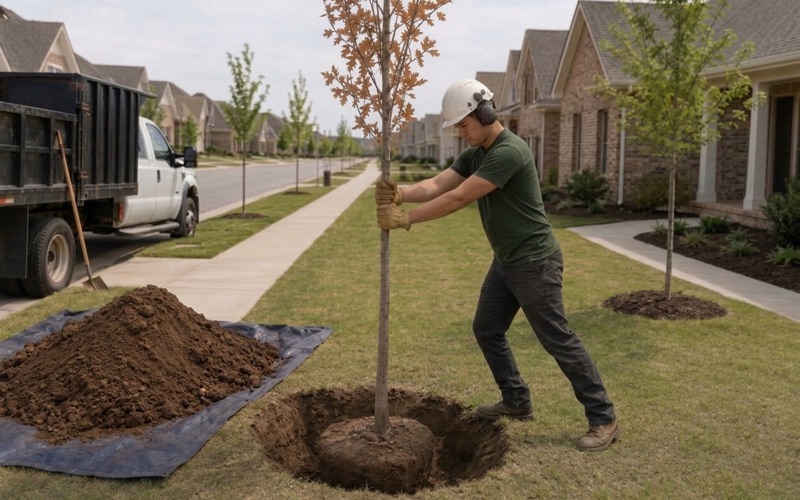
Smyrna Tree Removal has handled tree removal in Franklin for more than twenty years, and the first question we settle on a job here is not who owns the tree. It is whether the parcel sits inside an approved plan. Franklin ties removal to that approval rather than to the deed, which means the document governing your back yard may well have been stamped before you bought the house.
That is a different starting point than most of Middle Tennessee gives us. A development plan, a site plan, a preliminary plat, a building permit or a grading permit can each carry the tree question along with it, and until the tree side of that file is documented, the permit that lets a machine touch the ground does not come out.
We read the rules for the city each tree actually stands in, because our service area crosses six counties and the answer changes at the line. On a Franklin address that means establishing the approval status of the parcel before we put a number on the work, so nothing in the estimate is waiting on a sign-off nobody has asked for yet.
Removal follows the approval, not the deed
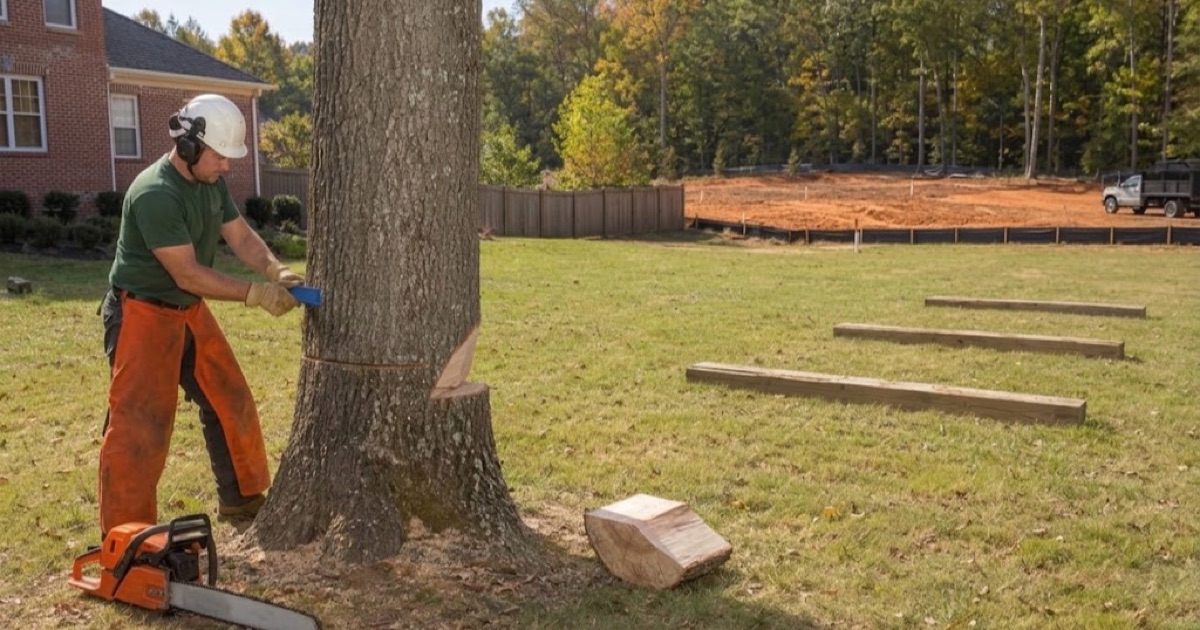
There are several ways a removal in this city can be covered by an approval. It can come through the development plan, site plan or preliminary plat that governs the subdivision, through a building permit or a grading permit on the individual lot, or through a stand-alone tree removal permit when none of those apply. What decides your timeline is which of them already exists for your address.
Which lots the tree removal permit reaches
A tree removal permit is required for trees cut on any commercial, industrial or multifamily lot of any size, and on a single-family lot larger than 1 acre. It is not required on a single-family lot of 1 acre or less. That threshold is written about the lot rather than about the tree, so two neighbors looking at the same declining hackberry can be in two different processes.
Who reviews and who signs
Applications go to the Department of Building and Neighborhood Services at 615-794-7012. The Department of Planning and Sustainability and the City arborist review the application and recommend approval, approval with conditions or denial, and Building and Neighborhood Services approves, approves with conditions or disapproves. Two desks means two calendars, and we would rather build that into the schedule up front than call you the morning of to say the crew is standing down.
What we ask for on a first call is short: the address, whether the lot is over an acre, and whether anything is currently permitted on it. That is usually enough to tell you whether you are looking at a same-week removal or a submittal, and it costs nothing to ask before a crew is on the calendar.
Looking for tree-removal closer to Lebanon? See Lebanon Tree-Removal.
When a grading permit is what actually triggers the rule
A great many removals in Franklin never begin as tree jobs. They begin as a pool, an addition, a new drive, a garage pad or a detention basin, and the tree becomes an issue only because the earthwork needs a permit. The city releases no building permit and no grading permit until tree removal compliance or an exemption is documented, so the file holding up the excavator is the tree file.
Land disturbance is the trigger, not the chainsaw
Where a project disturbs ground, the land disturbance permit and the grading permit are what the tree question rides along with. That reverses the order most people expect: the trees are settled during the approval, and the removal is the execution of a decision somebody already made on paper. If you are being asked for a survey, a plan sheet or a count before anyone will discuss a crew date, this is why.
Stormwater sits in the same conversation
The city also requires stormwater management features to be located and designed to avoid tree removal, which puts basin and bioretention layout and tree retention on the same sheet of the plan set. A drainage decision made months before ground breaks can commit a tree, or spare one, without anybody standing under it.
A settled back yard against a lot inside an active approval
Of Franklin’s 36,239 housing units, 53.5 percent were built in 2000 or later and only 4.8 percent predate 1960. So the two jobs we quote most often here are near opposites: a mature canopy on a lot that has been settled for decades, and a newer lot still carrying conditions from the approval that created it.
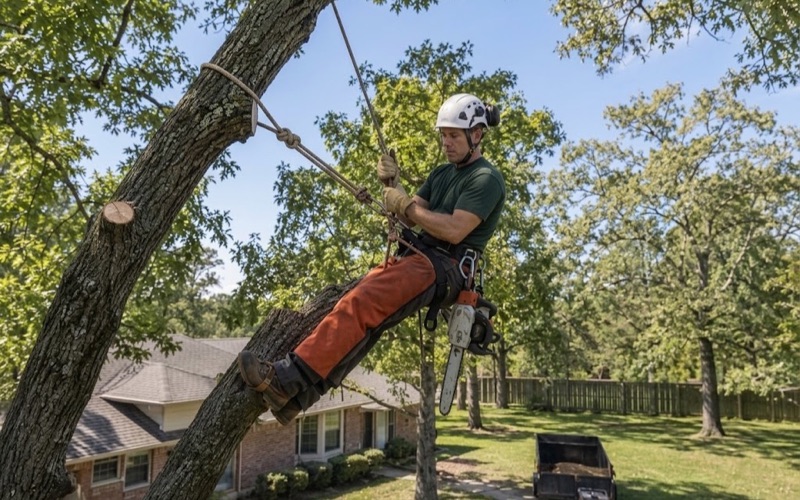
On a settled single-family lot of 1 acre or less, the permit generally does not reach the tree, and the work is planned around access, drop zone and what is under the canopy. We run compact tracked equipment that fits a back-yard gate so a subdivision tree does not have to become a crane job, and we keep crane and rigging capacity for the older, taller stock where it genuinely is one.
The critical lot is where the two cases meet
An individual residential lot holding a specimen tree is designated a critical lot on the final plat, and a lot of 1 acre or less loses its exemption when it carries that designation. Specimen trees are not to be cut, removed, pushed over, killed or otherwise harmed except by exemption, and work inside a specimen tree’s critical root zone requires documentation from an ISA Certified Arborist that no harm will result. Before we quote a removal on a platted subdivision lot, we want to know whether that plat reads critical.
What removing outside the approval costs
Removing or damaging a specimen tree is mitigated at two caliper inches of replacement for every caliper inch taken, and other protected trees at one caliper inch to one; where a site has no room, a payment into the city tree bank is allowed instead. Minimum canopy retention scales with the zoning district and with how much canopy a site already has, holding an R1 site somewhere between 15 and 26 percent depending on the band it falls in. Those figures are why a removal decided in the yard on a Saturday can cost several times the removal itself.
Topping is a code matter here
Excessive pruning and tree topping are written into the city’s tree protection standards as violations requiring mitigation rather than as poor workmanship. We work pruning to the objectives and cut types the ANSI A300 standard defines, and we do not top trees. Where a stem can be reduced, cabled or braced instead of taken down, we say so before we quote a removal.
What to establish before a crew is scheduled
Once the approval question is answered, three site facts decide what the day actually looks like: how deep the rock is, which utility owns the wire near the work, and where the wood goes. Each of them is cheaper to answer before we load the truck than after.
Depth to rock decides the stump
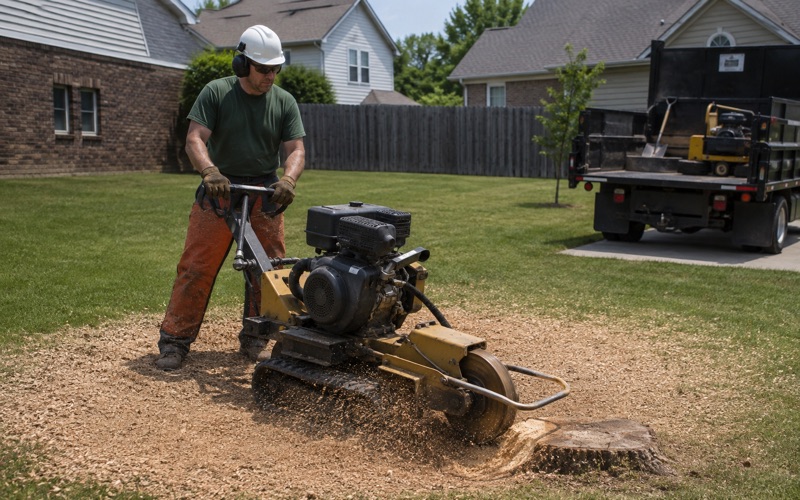
Williamson County’s soil-mapping standard records depth to rock in inches by soil series, and its worked examples are exactly the numbers a grinder cares about: Talbott at 20 to 22 inches to rock on 0 to 5 percent slopes, and Ashwood-Barfield-Rock Outcrops at 10 to 26 inches on 15 to 25 percent slopes. Rockland is defined as ground where 50 to 90 percent of the surface is exposed rock. A tracked stump grinder rated to cut 12 to 16 inches below grade is at or near refusal on the first of those and sitting on rock outright in the last.
That same standard names the shapes rock takes underground in this county: tabular, undulating, pinnacle and trough, floaters, and the stair-step ledge rock most typical of hillsides. A probe can read a weathered horizon as solid and can miss a buried floater completely. Depth to rock is a per-parcel number here rather than a citywide one, which is why we probe before quoting a grind depth instead of afterward.
Ice load, root plates and the line overhead
The failure work in Franklin arrives with ice. Winter Storm Fern moved through beginning early Saturday, January 24, 2026, and by the end of that weekend Williamson County had close to 15,000 outages, roughly 2,000 of them in Franklin. Over limestone this shallow a mature tree has no deep anchorage available to it, so saturated soil above a hard interface fails as a root plate, producing windthrow rather than a snapped stem, and that is what we plan storm response around.
Middle Tennessee Electric serves this city, and its no grow zone rule keeps vegetation 12 feet clear of the front of a pad-mounted transformer and 3 feet clear of every other side; its vegetation management line is 1-877-414-7685. We check which utility serves an address before quoting any work near a conductor, rather than assuming the last job’s answer carries over.
Where the wood goes, and what is in writing
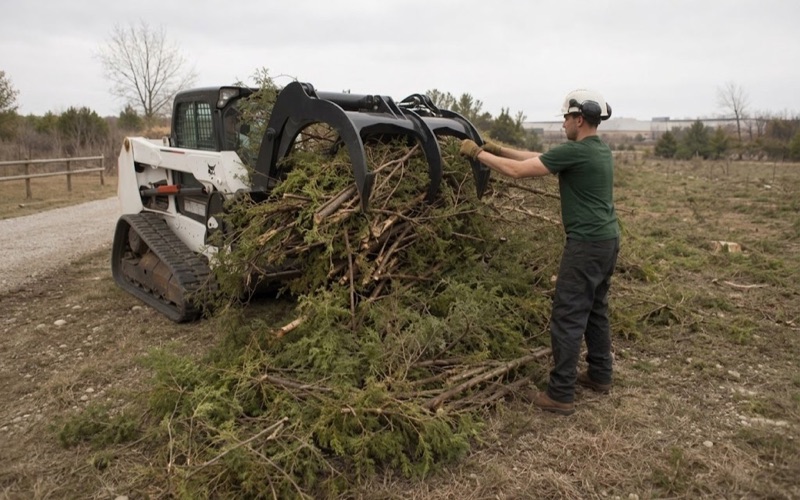
Franklin collects homeowner-cut brush placed at the edge of the street inside the right-of-way, limbs no longer than six feet, stacked end to end rather than tangled and kept clear of meters, boxes, mailboxes and parked cars; after a major storm the city suspends its usual excess-brush limits. That program is for what a homeowner cuts. What our crew cuts leaves on our truck, and we tell you that before the job rather than after.
Disposal in this county is priced by the ton. The Williamson County Landfill at 5750 Pinewood Road takes brush at $40.00 per ton, and the county’s landfill page states that beginning May 4, 2026 there is no free disposal there and all incoming loads are charged regular tonnage fees; convenience center brush intake was capped at three feet in length from the same date, which takes self-hauling a felled trunk off the table. We price disposal for the county a job is in, because the gate charges by the ton here and by the cubic yard one county over.
There is no trade-specific tree-care or arborist license in Tennessee, so the credential worth checking is ISA certification. Ask for the inclusions in writing as well: the trunk rounds, the stump, the grindings and the chips, so nothing about what stays in the yard is left to memory. Estimates are free, and where a tree’s condition is the thing in dispute we will put a written report in your hands that you can hand to a neighbor, an insurer or an HOA architectural review committee.
- 20+ Years in Middle Tennessee
- Free Written Estimates
- ANSI A300 Pruning, No Topping