Smyrna Tree Removal works tree removal in Forest Hills, TN, and the first thing we tell a homeowner here is that the city almost certainly has to sign off before a saw touches the trunk. Forest Hills requires a permit on most tree removals, and the handful of exceptions are written down and short. Twenty-plus years across Middle Tennessee has taught us that the answer changes at the city line, so we read the ordinance for the city the tree actually stands in rather than the one down the road.
That single fact reorders the job. Before we quote, we establish which category your tree falls into — a permitted removal, or one of the two exemptions the city puts in writing — because that decision drives the paperwork, the schedule, and whether anything has to be replanted afterward.
Estimates are free, and the inclusions go in writing before we start: the trunk rounds, the stump, the grindings and the chips. What follows is how the permit actually works here, in the order it comes at you.
Why a removal here starts at city hall
When Nashville and Davidson County consolidated their governments in 1963, several smaller cities were allowed to keep their existing charters and municipal authorities, and Forest Hills is one of them. It still runs a manager-commission government with its own mayor and commissioners inside Davidson County. Our reading of that arrangement is that the city’s own zoning ordinance, not Metro’s tree provisions, is what governs a tree standing on a private lot here.
The instrument is Section 6.05 of the Forest Hills Zoning Ordinance, Woodland and Tree Protection, codified at Title 14, Chapter 2 of the municipal code and amended by Ordinance 2021-03. The city states plainly that a permit is required on most tree removals. That binds homeowners and contractors alike, and it is why we ask for an address before we talk about a price.
The ordinance names where its standards bite: approval of a newly platted lot, construction of a new residential dwelling, any land disturbance requiring a stormwater permit, removal of a specimen tree from any lot, and timber harvesting or clearcutting. A single large tree coming off an established lot can reach the ordinance through that specimen clause alone, with no construction involved at all.
The one thing that is never negotiable
Clearcutting and timber harvesting are strictly prohibited, and the landscaping provisions separately state that clearcutting shall not be permitted on any lot. A property where clearcutting occurs takes a three-year suspension of all development approvals, rezoning requests and land disturbance permits, running from the time it happens. That penalty attaches to the land rather than to whoever ran the saws, which is why we will not take a lot to bare ground here however the request is worded.
Who signs off
The Board of Commissioners adopts and administers the ordinance. The application goes to the City Manager, working with the City Arborist — a city agent or an independent certified arborist retained by the city — who approves it, returns it for revision, or denies it. Nobody else can wave a removal through, and neither can we.
Looking for tree-removal closer to Franklin? See Tree-Removal Services in Franklin.
The exceptions the city writes down
The exemptions are real and they are narrow. The city names two: the removal of dead trees, and the removal of trees that have fallen due to storms or other natural occurrences. Everything else runs the permit route, including a healthy native tree in an inconvenient place — those are usually not allowed to come down without good reason, and otherwise have to be replaced inch for inch with a similar species.
Proving a tree was already dead
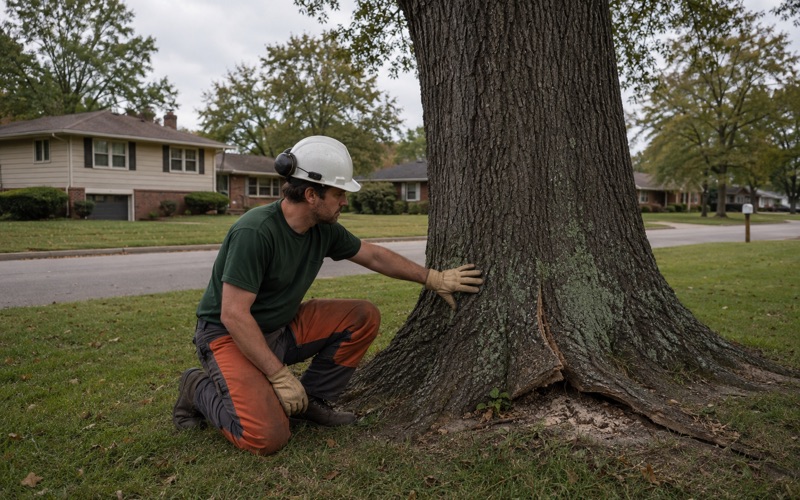
An exemption you cannot document afterward is not worth much. Before we remove a dead tree under it we run a tree risk assessment and put the findings in writing: species, diameter at breast height, the state of the root flare and root collar, deadwood through the crown, any conk at the base or on the stem, and photographs from more than one side.
That written record is what a homeowner can hand to the city, a neighbor or an insurer if anyone asks a year later why a large tree is missing from a lot with a canopy number to meet. Where the condition is genuinely arguable — declining rather than dead — a consulting arborist report is the cleaner route, and we will say so instead of stretching the exemption to fit.
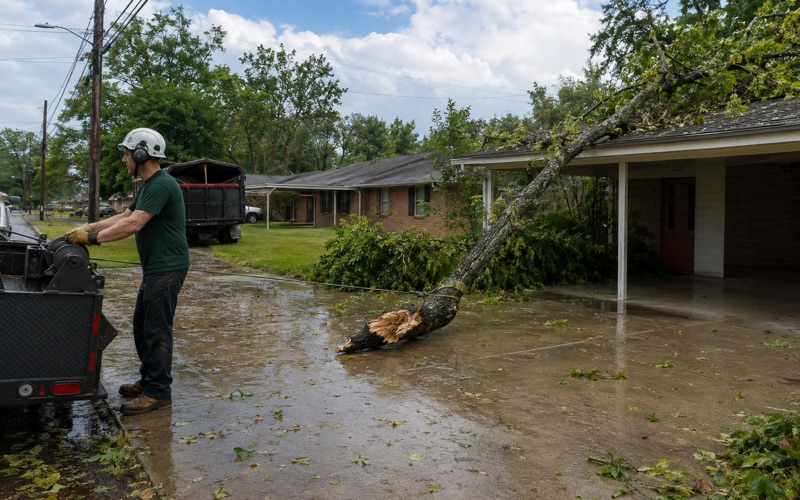
Trees the storm already took down
The written exception covers trees that have fallen. A standing tree that lost half its crown in the same storm has not fallen, and we treat that one as a permitted removal unless the city says otherwise. The distinction sounds pedantic right up until the inspection.
The ordinance also carries a storm clause that outweighs everything else in it during a bad week: in a natural disaster or other emergency, the City Manager may suspend the tree ordinance where it would prevent, hinder or delay necessary action in coping with the disaster. The January 24-25, 2026 ice storm was that kind of week — a glaze to more than half an inch of ice, a quarter to a half inch typical, power out to as many as 230,000 households across the Nashville area and more than 37,000 customers still without it on February 1. We plan storm response around ice loading and the horizontal limb failures it produces, because that is the failure mode this area actually records.
What the city asks for before it issues the permit
Before any tree clearing, removal, development work or land disturbance in excess of 2,500 square feet, the applicant must prepare and submit a survey of all trees on the lot. On a wooded one- to two-acre parcel that is the longest part of the process, and it is worth starting before you have a removal date in mind.
Canopy math and the two-year lookback
Retention runs off Table 6.05(b), which sets how much of a lot’s canopy has to stay based on how much of the lot trees cover to begin with. There is a lookback: trees removed in the previous two years and not replaced with a tree of eight inches DBH or greater are counted back into the existing inventory, whether or not that removal was permitted. A removal done last season still shows up in this season’s arithmetic, which catches people out.
If a removal would drop a lot’s canopy below the level its zoning has to hold, the city looks for a tree planting plan filed alongside the application rather than a bare request. We would rather have that settled on a first visit than have you discover it after a crew is booked.
Specimen trees, and what replaces them
A specimen tree is one in fair or better condition measuring 30 inches DBH or more for large hardwoods, or 36 inches for large softwoods, where fair or better means a life expectancy greater than fifteen years, a structurally sound trunk and no major insect or pathological problem. A smaller tree can still qualify on historical significance, including a listing on the state Landmark and Historic Tree Registry. Removing one from any lot pulls the ordinance in regardless of what else is happening on the property.
Where replanting is owed it runs at eighty trees per acre disturbed beyond the retention standards, or an inch-by-inch caliper replacement, with replacement trees at least two inches DBH at planting and maintained through a three-year establishment period that resets if they do not survive. The city inspects before, during and after the work to confirm trees were adequately protected and the plan was followed, and a violation carries a fifty dollar per day fine until it is remedied.
When the arithmetic points the other way, we say so. A co-dominant stem with included bark can often be cabled and braced, and a heavy crown can be reduced or thinned, and on a lot that has a retention figure to hold, keeping the tree is frequently the cheaper answer.
Doing the work on a wooded hillside lot
The city covers a little over nine square miles of steep wooded hills at roughly 653 feet of elevation, and most residential parcels run one to two acres. Any lot with ground at 800 feet or above, or containing steep slopes, also sits in the Hillside Protection overlay, where the more stringent of the two sets of standards controls. We establish that before planning access, not after.
What the ground does to the equipment
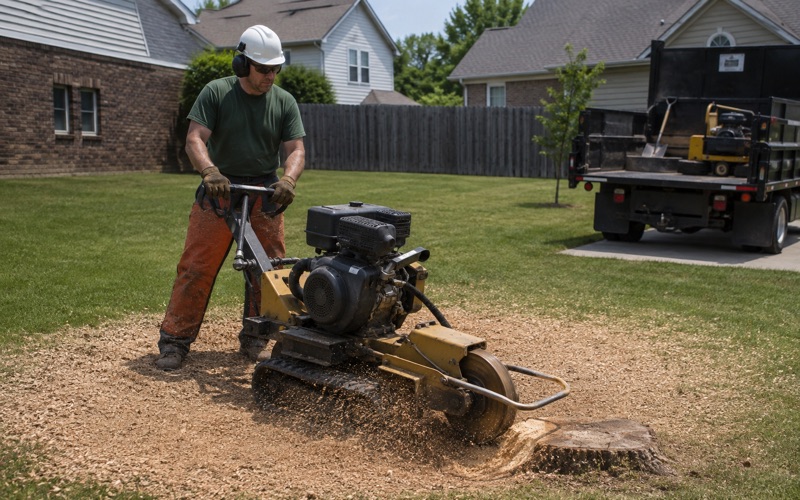
Bodine is the most extensive soil series mapped in Davidson County, on 20 to 50 percent slopes, somewhat excessively drained, formed in colluvium or residuum weathered from cherty limestone and carrying 35 to 80 percent chert fragments. Bedrock sits more than five feet down in it, but the loose rock is what wears out a tracked stump grinder, and a root plate spread through that matrix is deep without being well anchored. Lower down, Mimosa is the clayey counterpart — well drained but slowly permeable — and slow permeability under a full crown on a slope after a long rain is the windthrow mechanism here.
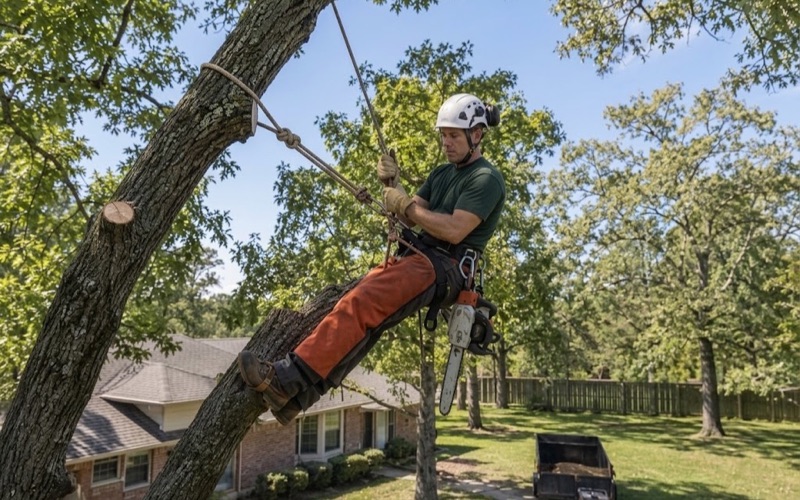
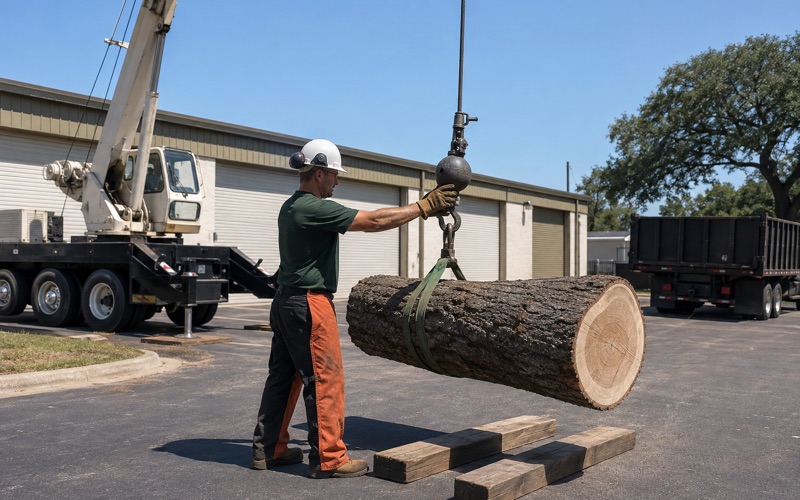
The canopy above it is Outer Nashville Basin hardwood: white oak, northern red oak, tuliptree, sugar maple, hickory and eastern redcedar. Compact tracked equipment gets us through a back-yard gate on most of these lots, so a mature tree does not automatically become a crane job, and we hold crane and rigging capacity for the ones that do.
Lines, and where the brush goes
We confirm which utility serves an address before quoting anything near a conductor. Nashville Electric Service now clears fifteen feet below its lines for all species in a horseshoe pattern, up from ten, and has stopped ground-to-sky trimming, leaving lower vegetation and limbs where it can. It kept that standard after Metro Council asked for a pause and did not get one.
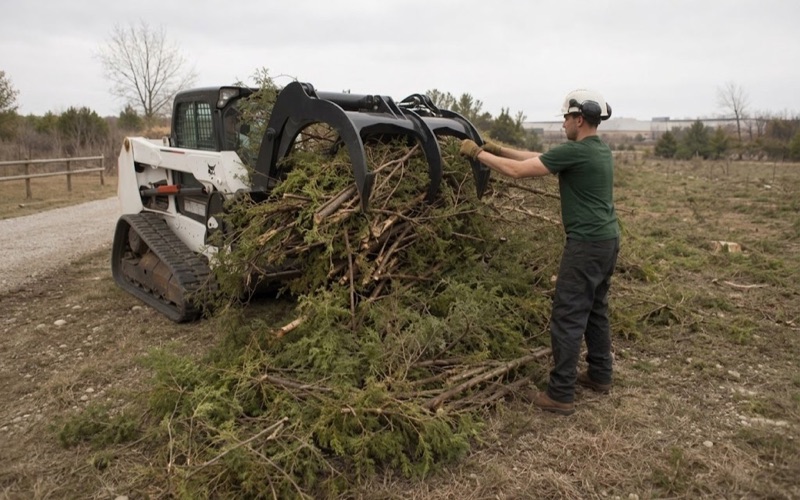
Debris is the other thing that catches people. Metro does not collect brush in self-incorporated cities and names Forest Hills among them, and the city’s own free chipping and monthly leaf pickup is curbside only, with the contractor unable to enter private drives. None of that is meant to absorb contractor-cut wood, so we haul what we cut and price the disposal for the county the job is in.
- 20+ Years in Middle Tennessee
- Free Written Estimates
- ANSI A300 Pruning, No Topping