Smyrna Tree Removal has been running emergency tree removal and storm response in Middle Tennessee for more than twenty years, working trees off houses, vehicles, lines and driveways in Smyrna, TN and serving surrounding cities including La Vergne, Nolensville, Murfreesboro, Brentwood and Mount Juliet. Storm calls are answered against the events this region actually records rather than a generic script written somewhere with a coastline.
That distinction shows up in what we prepare for. The USDA Forest Service model for the woodland system covering this area names ice storms among the disturbances that shape it, so glaze is a documented structural agent here rather than an occasional novelty. During the January 2026 winter storm the National Weather Service recorded 2.1 inches of snow and 0.3 inches of freezing rain in Rutherford County at the Smyrna-Rutherford County Airport, with temperatures down to minus 4 degrees, and Middle Tennessee Electric’s own leadership described crews finishing a repair and watching more trees come down on the same line as they drove away.
The second local factor is underfoot. Rooting depth on much of this ground is capped by limestone within a foot or two of the surface, so a mature tree stands on a wide, thin root plate. In a saturated winter the failure that arrives is often the whole tree turning out of the ground rather than a trunk breaking, and that changes how a leaning stem has to be approached.
What Actually Counts as an Emergency
A Tree on a Structure
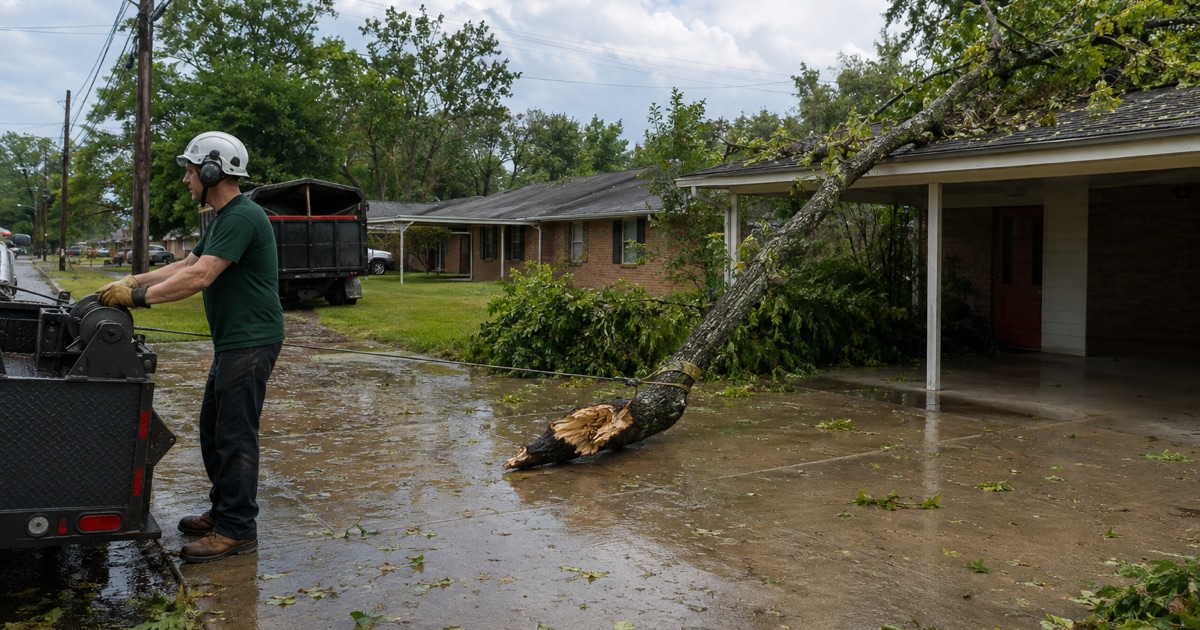
A stem resting on a roof is a load that has not finished moving, and the order of cuts decides whether the rest of it comes through the ceiling. These are dismantled in controlled sections off the roofline, rigged rather than dropped, with the weight taken by equipment instead of by the building. Everyone comes out from underneath first, including from the rooms below.
A Tree Holding a Line or Blocking the Only Way Out
A limb pinning a service line, or a trunk across the single access to a property, is urgent even where nothing is damaged, because it removes an option somebody may need. The line has to be identified and dealt with by its owner before any cutting. Access is often cleared in stages so a vehicle can move long before the whole tree is gone.
The Hung Limb and the Loaded Stem
The pieces that hurt people are frequently the ones still in the tree: a broken limb caught in the crown, a stem bent and holding energy, a split that has not finished. Cutting a loaded stem in the wrong place releases it explosively. These are relieved deliberately with rigging and, where the load is unreadable from the ground, from a lift rather than by hand.
The Storms This Area Records
Ice and Glaze Loading
Glaze accumulates on every twig and multiplies the weight a crown carries, and unions fail before sound limb wood does. A crown carrying co-dominant stems with included bark is carrying its weakest joint at the point of highest stress. Freezing rain of a few tenths of an inch is enough to bring down limbs across a whole area at once, which is why demand spikes the same night.
Straight-Line Wind, Tornado and Derecho
Wind events across Middle Tennessee produce a different signature: whole trees laid over in one direction, tops snapped out, and debris fields rather than individual failures. The work is slower because every stem in a tangle is loaded by the ones around it, and the safe route through a pile is rarely the obvious one.
Saturated Ground and Whole-Tree Windthrow
The thin soils here dry through summer and saturate through winter and spring, putting the wettest ground and the ice season in the same months. A root plate that would hold in dry conditions releases when the soil around it is soft, so we treat every leaning tree after a wet-season storm as one that may still move, and stabilize before cutting rather than after.
Working Safely on Damaged Wood
Storm Wood Does Not Behave Like Sound Wood
A tree that has failed has already broken somewhere, and the remaining fibers are holding tension and compression in places a saw cannot see. Standing on it, cutting it in the wrong sequence or assuming a limb is dead weight is how storm work injures people. Every piece is assessed for what it is holding before a cut is planned.
Minimum Approach Distance and Live Conductors
The ANSI Z133 safety requirements set minimum approach distances to energized conductors, and no rule in this trade is under more pressure after a storm than that one. Nobody works inside that distance until the utility has confirmed the line is dead or physically dropped. A crew that will cut near a live primary to save you a wait is not a bargain.
Crane and Rigging on a Compromised Stem
Where a damaged tree cannot safely carry a climber, the answer is to take the load somewhere else. A crane picks sections clear of a structure, and a friction lowering device, rigging block and bull rope sized against a known working load limit lower pieces under control. Both are slower to set up and considerably faster than repairing what a dropped limb hits.
Utilities, Outages and the Right First Call
Knowing Which Provider Serves the Address
Four electric utilities serve addresses across this service area, and their policies on clearance, response and service drops are not the same. Middle Tennessee Electric publishes a right of way 40 feet wide, 20 feet on each side of the line. Establishing which provider covers your meter is the first thing we do on any line-involved call, because it determines the entire sequence.
The Primary Line Against the Drop to Your House
A tree across a primary conductor is the utility’s work, and it will be prioritized against their own outage map rather than your yard. The service line running to the weather head is the customer’s side in most cases, which is why an owner who calls about it is usually told to hire a private crew, and why we arrange the disconnect ourselves.
Sometimes Waiting for the Utility Is the Fast Route
On a line-involved job the honest answer is often that nothing useful happens until a truck has been and gone. We say that plainly instead of billing an hour to stand in the yard, and we schedule our own arrival against the utility’s realistic window so the tree comes off within minutes of the line being made safe.
Insurance, Documentation and the Aftermath
What a Policy Usually Responds To
Coverage generally follows damage to an insured structure, and debris removal usually rides on that damage rather than standing alone, so a healthy tree that falls into an open yard is frequently the owner’s expense. Ice and snow load and falling objects are common named causes. We tell you which side of that line the job sits on before you open a claim.
The Tree That Fell on a Car
A vehicle struck by a tree is claimed against the comprehensive coverage on the auto policy rather than the homeowners policy, and it is the misunderstanding that costs owners the most time after an event. We photograph the vehicle with the tree still on it, lift the stem clear rather than dragging it across panels, and give you the written account of what came down.
Debris, Receipts and a Claim File That Holds Up
Everything is itemized: the tree, the method, the disposal and any mitigation. The debris leaves with us, because a hired crew’s brush is not something the town collects, and the disposal is priced against the county gate that serves the address. What you are left with is a file an adjuster can work from, whether or not the claim turns out to be worth filing.
- 20+ Years in Middle Tennessee
- Free Written Estimates
- ANSI A300 Pruning, No Topping