Smyrna Tree Removal has been running crane assisted tree removal in Middle Tennessee for more than twenty years, on the mature canopy that stands over houses, pools and property lines around Smyrna, TN. It is not the default method and it should not be, but where a tree cannot be safely climbed or safely dropped there is no substitute for taking the load from outside the tree.
The local case for it is straightforward. The residential stock in and around the hub is not uniformly new, and older lots carry large hardwoods planted close to houses long before anyone thought about drop zones. Add subdivisions built tight, back yards with a single narrow gate, and pool decks under the canopy, and you get the classic crane job: a big tree with nowhere for anything to fall.
The other driver is condition. A tree killed by borers, hollowed at the base or damaged in a storm may still stand perfectly well and still be unsafe to have a climber in. A crane keeps the worker out of the compromised structure entirely, which is a safety argument rather than a convenience one.
When a Crane Is the Right Answer
Trees Too Close to a Structure
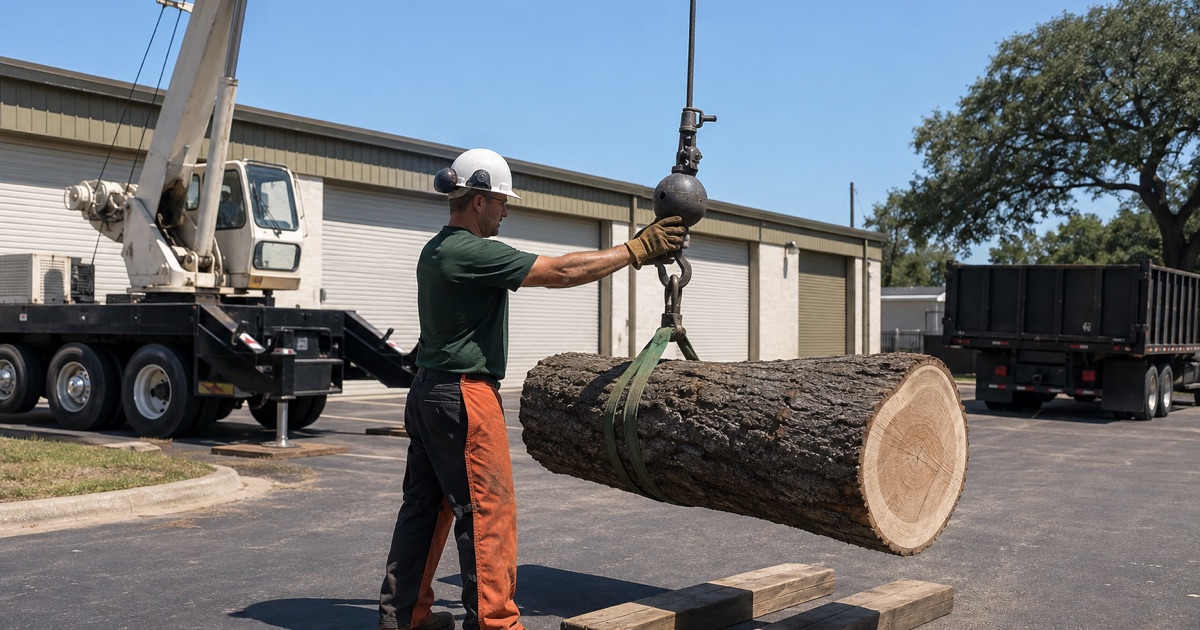
Where the crown overhangs a roof, a conservatory, a pool or a neighbor’s fence, every piece cut has to be controlled from the moment it separates. A crane holds the section before the cut and carries it away from the structure rather than lowering it past one. That converts the highest-risk part of the job into a routine lift.
Trees That Should Not Be Climbed
Decay at the base, an ash killed by emerald ash borer, a split union or storm damage all mean the tree cannot be trusted to hold a climber and the loads climbing imposes. The crane takes the worker’s weight and the piece’s weight out of the equation, and the pick plan is built around what the wood can still be trusted to do.
Sites With No Drop Zone
Some lots simply have nowhere to put anything. A narrow side yard, a rear boundary against a neighbor’s outbuilding, mature landscaping worth more than the removal, or a septic field that must not be driven on all remove the option of felling and processing on the ground. Lifting the tree out over the roof to the street is often the only route.
How a Crane Removal Runs
The Pick Plan and the Set-Up
Before anything is cut we plan the picks: where the machine sets up, what each section weighs, where it lands, and the order that keeps the remaining tree balanced. Weight is estimated conservatively against the working load limit at the radius involved, not at the boom’s headline figure, because capacity falls away as the boom reaches out.
Rigging and the Climber’s Role
A climber or a lift operator still goes to the tree to set the choker and make the cut, and the sequence is agreed by hand signal or radio before anyone leaves the ground. Slings, shackles and the rigging block are matched to the section, and the cut is made only once the piece is under tension and the operator has confirmed the load.
The Landing Zone and Processing
Sections come to a cleared landing area where a ground crew cuts them down and feeds the chipper. That area needs room, protection underneath and control of anyone walking past it, which is most of the reason a crane job takes street space. Rounds are stacked or loaded depending on whether the wood is staying with you.
Cost, Access and the Alternatives
Why a Crane Day Can Cost Less Than a Rope Job
The machine is expensive by the hour and cheap by the tree. Work that would take a climbing crew two or three days can finish in one, with fewer people, less time in the tree and no piece dropped anywhere near the house. On the jobs where it fits, comparing day rates rather than totals is what makes a crane look unaffordable when it is not.
Street Access, Outriggers and Overhead Lines
Set-up governs everything. We check the approach for width and overhead clearance, confirm the ground will carry the outrigger loads, and establish where the conductors run, because the boom has to stay outside the minimum approach distance to any energized line for the whole operation. That survey happens at the estimate, not on the day.
When Compact Tracked Equipment Wins Instead
Plenty of back-yard removals that owners assume need a crane do not. Compact tracked equipment fits a standard subdivision gate, spreads its weight across the lawn, and handles a mid-sized tree perfectly well with conventional rigging. We measure the gate and look at the drop zone before reaching for the expensive answer, and we say when the cheaper one is genuinely sufficient.
- 20+ Years in Middle Tennessee
- Free Written Estimates
- ANSI A300 Pruning, No Topping