
Smyrna Tree Removal has worked as the arborist on Middle Tennessee properties for more than twenty years, inspecting, diagnosing and documenting trees in Smyrna, TN and serving surrounding cities including La Vergne, Nolensville, Murfreesboro, Brentwood and Mount Juliet. This is the part of the trade that decides whether a saw is needed at all, and it is deliberately kept separate from the removal quote.
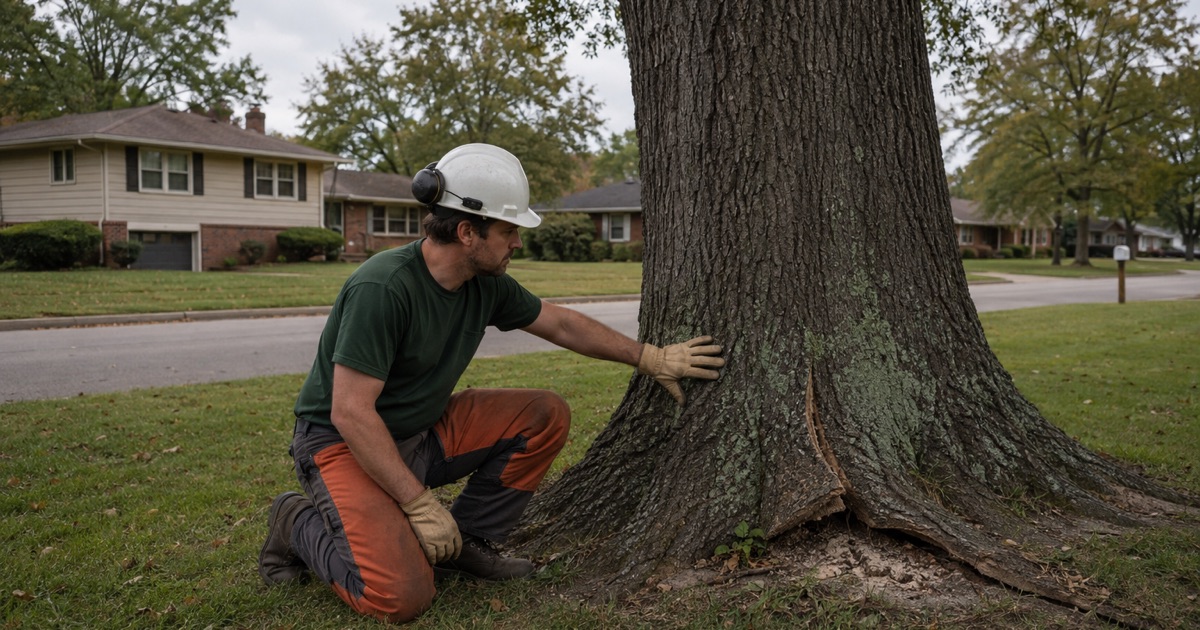
What you get is a tree risk assessment carried out on the ground and, where the crown warrants it, from inside the tree, followed by a written record that a third party can act on. Homeowners bring us in when a tree has changed since last summer. Insurers, buyers and HOA committees bring us in when somebody needs a document rather than an opinion.
The local part matters more here than it does in most regions. On the shallow limestone soils of the Inner Nashville Basin a tree’s roots are capped by rock, so the failure to plan for is the whole root plate turning out of saturated ground rather than the trunk snapping. Reading that correctly changes both the verdict and the price.
What a Tree Risk Assessment Actually Involves
Levels of Assessment and Which One You Need
Assessment comes in depths, and paying for the deepest on every tree is waste. A drive-by look across a property flags the obvious; a full walk-around of a single tree covers the root collar, the trunk, the unions and the crown from every side; an advanced assessment adds climbing inspection, decay measurement or a root investigation. We tell you which level the question actually requires.
Targets, Likelihood and Consequence
Risk is not a property of the tree by itself. A hollow hackberry in the back of a five-acre lot and the same hollow hackberry over a child’s bedroom carry identical defects and completely different risk, because the target changed. Every assessment records what stands within a falling distance, how often people are under it, and what a failure would actually reach.
The Measurements That Go on the Page
Diameter at breast height, crown spread, the height of the first union, the extent of visible decay and the degree of lean are all recorded as numbers rather than adjectives. “Large” and “leaning badly” mean nothing to the next reader, whereas a measured lean and a measured cavity can be compared against the same tree two years later to show whether anything moved.
Reading Defects on a Middle Tennessee Tree
Co-Dominant Stems and Included Bark
Where two stems of similar size compete from a low fork, bark often becomes trapped in the union instead of wood knitting across it. That union carries the load until an ice event or a wet snow finds it. Callery pear, silver maple and many yard-grown maples in these subdivisions are built this way, so the union is the first place we look and photograph.
Conks, Cavities and Decay at the Root Flare
A fruiting body at the base is the visible end of a decay process that started years earlier inside the stem. We open the root flare where it is buried, sound the buttress, and estimate how much sound wall is left around the circumference, because a stem can lose a surprising fraction of its interior and still stand until the day the wall thickness drops past its margin.
Root Plate Movement on Shallow Limestone
On a Barfield or Gladeville soil the rooting depth is measured in inches to bedrock, so mature trees hold themselves up with a wide, thin plate. Cracked soil on the uphill side, a raised mat of turf behind the trunk, or roots visibly lifting are the signs that the plate has begun to work, and they carry far more weight here than the same signs would on deep ground.
The Written Report and Who Reads It
Reports for an Insurer or Adjuster
An adjuster is deciding from a desk on a file that will be read by somebody else later. Our report gives species, size, the observed defect, the direction of failure and the damage path, keeps observation separate from recommendation, and dates everything. That structure is what lets a claim be evaluated without a second site visit.
Reports for an HOA Architectural Review Committee
Committees meet on a schedule and vote on paper. A request to remove a tree fails as often for being unsupported as for being unreasonable, so the report is written to be attached to minutes: what the tree is, what is wrong with it, what the alternatives were, and why the recommendation is what it is. Approval or refusal, the record is complete.
Reports for a Neighbor or a City Notice
Tennessee treats an encroaching tree as a nuisance only where it causes actual harm or poses imminent danger of actual harm, so a fence-line disagreement usually turns on evidence rather than principle. A dated report describing a specific defect converts an argument into a record, and it is also the document that answers a municipal abatement notice with something more than a promise.
When the Answer Is Care Rather Than Removal
Root Collar Excavation and Soil Work
A tree buried by regraded fill or a mulch volcano rots at the collar while the crown takes the blame. An air spade opens the flare without cutting roots, and the same tool performs soil decompaction and radial trenching where construction traffic has closed the pore space. Where that is the diagnosis, the treatment costs a fraction of the removal it prevents.
Support Systems Instead of a Saw
A union with included bark can often be supported rather than lost. A dynamic cabling system installed at the correct height in the crown, extra high strength cable where a static system suits better, or a brace rod through a union that has already begun to separate, will hold a good tree through the loads that would otherwise end it. Hardware gets re-inspected, not installed and forgotten.
Re-Inspection Intervals
Most trees we assess do not need work this year. They need a date. A defect that is stable at a known size, on a tree with a known target, gets a written interval and a note of exactly what to compare against, so the next look is a measurement rather than a fresh opinion. That is how a monitoring plan stays cheaper than a removal.
Our Step-by-Step Tree Risk Assessment Process
Step 1: The Question and the Target
We start by asking what decision the assessment has to support, because a report for an insurer, a committee and a worried owner are not the same document. At the same time we establish what stands within reach of the tree, which is half of the risk before a single defect has been recorded.
Step 2: Ground Inspection
The walk-around covers the soil around the root plate, the root collar, the trunk on all sides, the major unions and the crown read from several angles. Buried flares are opened where needed. Anything ambiguous from the ground is marked for a closer look rather than guessed at.
Step 3: Advanced Inspection Where It Is Warranted
Where the crown is dense, the union is high, or the consequence of being wrong is a roof, we climb the tree or bring a lift and inspect the structure directly. Decay is measured rather than estimated when the reading will change the recommendation.
Step 4: The Written Report
Measurements, photographs, observed defects, targets and options go into a single document, with what we saw kept clearly apart from what we advise. Costs are given for each option, including the option of doing nothing on a stated interval.
Step 5: The Follow-Up
If work follows, it is scheduled against the report and the report is not rewritten to justify it. If monitoring follows, we come back on the interval and record what changed, so you hold a history of the tree rather than a series of unrelated visits.
- 20+ Years in Middle Tennessee
- Free Written Estimates
- ANSI A300 Pruning, No Topping